Dive Brief:
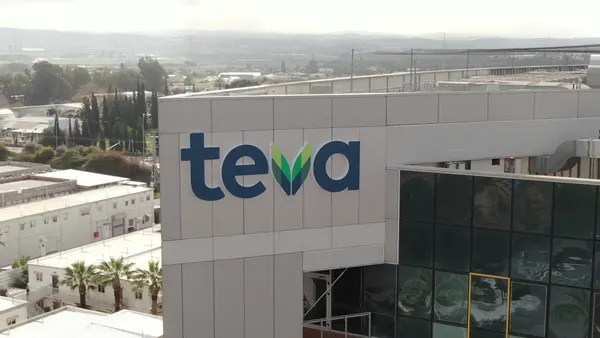
- Blackstone Life Sciences is widening its presence in drug development, announcing Tuesday a $400 million commitment over four years to support Teva Pharmaceutical’s work on a late-stage gut disease drug likely to be in a hotly contested class.
- Per deal terms, if the drug, called duvakitug, gains Food and Drug Administration approval, Teva will owe a milestone payment to Blackstone, along with additional payouts and royalties based on commercial sales. Blackstone has signed similar deals with Moderna, Alnylam Pharmaceuticals and Autolus Therapeutics.
- Duvakitug is in Phase 3 clinical trials that will enroll more than 3,000 people with ulcerative colitis or Crohn’s disease and follow them for up to 40 weeks. The deal will help subsidize Teva’s research and development spending, which topped $1 billion in 2025.
Dive Insight:
Clinical research is the foundation of the biopharma industry, building a rationale for patients to take drugs and insurers to cover them. But it often takes hundreds of millions or billions of dollars of investment before a drug can earn a single dollar, which is why smaller biotechnology firms often seek licensing deals with big pharma or sell out before their medicines get to market.
Teva is a large player itself, recording more than $17 billion in sales revenue in 2025 from its mix of generics and sterile injectables, biosimilars and branded central nervous system drugs like the migraine treatment Ajovy and long-acting schizophrenia medicine Uzedy. It has struggled with profitability for years, however, especially since one of its biggest-ever franchises, the multiple sclerosis shot Copaxone, lost all of its patent protections in 2018.
Last year, Teva reported net income of $1.4 billion. The company now sees itself in the midst of a “pivot to growth” period.
Excessive spending on R&D could cloud that picture, and in 2023 Sanofi paid $500 million up front to collaborate on duvakitug. Teva says the Blackstone deal is another way of hedging its bets.
”By pursuing disciplined, capital-efficient partnerships, we are accelerating pipeline advancement while maintaining financial strength,” said Evan Lippman, Teva’s executive vice president for business development, in a statement.
Should duvakitug succeed in the clinic and make it to the market, it could very well face additional challenges. It’s a type of drug called a TL1A inhibitor, and competitors from Merck & Co., Roche and AbbVie are also quickly advancing.
Merck’s drug, which it acquired in a $10.8 billion deal for Prometheus Biosciences, is due to report Phase 3 data later this year, while Roche’s — itself part of a $7 billion buyout — is also in pivotal testing.