Dive Brief:
- A protein degrading eczema drug developed by Kymera Therapeutics met the main goals of a Phase 2 clinical trial, significantly reducing disease severity in enrollees who got it compared with those given a placebo, the company said Monday.
- Codenamed KT-621, the drug demonstrated efficacy comparable to injectable biologics like Sanofi and Regeneron Pharmaceuticals’ Dupixent, according to Wall Street analysts. One of the tested doses achieved an average 72% reduction on an eczema severity scale after 16 weeks, 45 percentage points greater than in enrollees who got a placebo.
- Kymera said it plans to initiate a Phase 3 trial in eczema — also called atopic dermatitis — by mid-2027, while a Phase 2 trial in asthma is expected to read out by late next year. Company shares had risen 34% by late Monday morning, adding more than $3 billion in market valuation.
Dive Insight:
Eczema is a big business, with Dupixent alone recording 15 billion euros, or around $17.4 billion, through the first nine months of 2026. Dupixent is in its 10th year on the market and is due to lose patent-protected exclusivity in the U.S. in 2032.
KT-621, therefore, must compete not just with Dupixent and other biologics like Eli Lilly’s Ebglyss, but also any biosimilars that can be expected to soon enter the market after key patents expire.
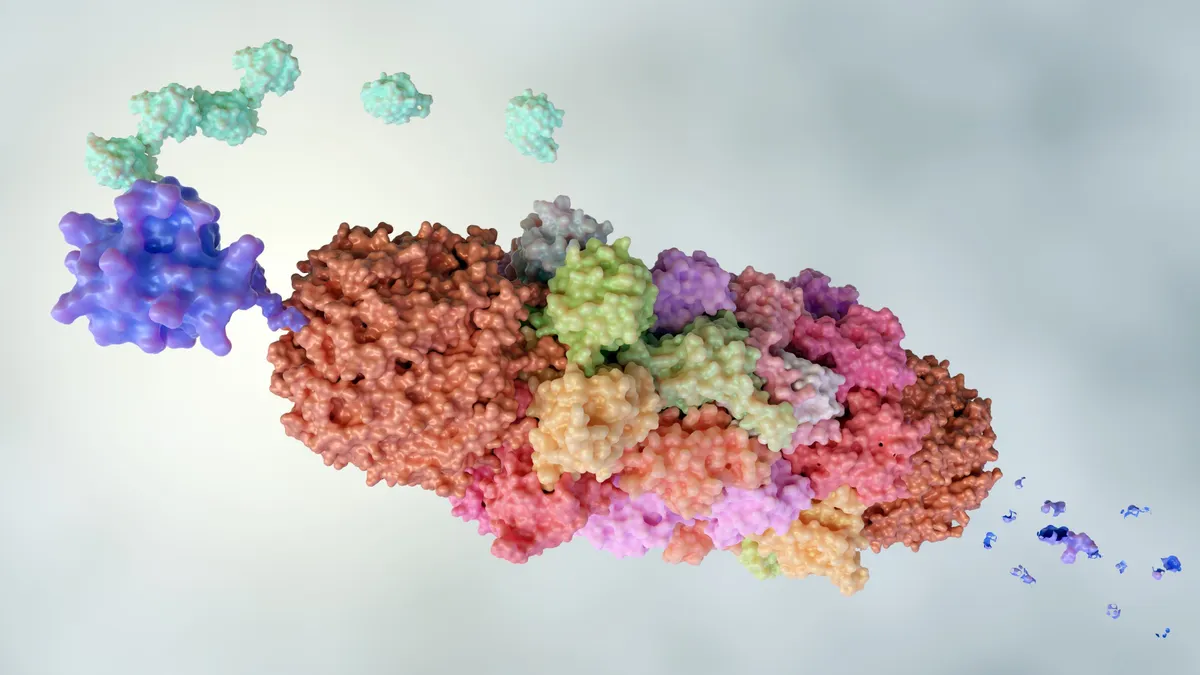
With KT-621, Kymera is seeking to tamp down the same inflammatory processes as Dupixent and Ebglyss. But instead of blocking signaling proteins related to allergic conditions, it degrades a transcription factor on the same pathway by triggering cellular trash disposal systems.
The trial Kymera reported today, titled BROADEN2, enrolled 244 people and randomized them into four roughly equal-sized groups to take one of three doses of KT-621 or a placebo. The primary goal was the score on a scale called the Eczema Area and Severity Index, or EASI. The best score of 72% reduction came from the people who got the mid-dose, with the low-dose group seeing their EASI scores drop 64% and the high dose 61%.
As a secondary goal, the trial also measured the proportion of patients who had a 75% reduction in their EASI scores. In the mid-dose group, 62% achieved this mark, compared with 22% of the placebo group.
The drug also appeared safe, with most side effects proving mild or moderate. Higher rates of conjunctivitis, a known side effect, were detected in the people receiving the study drug, but none of the people who got it quit taking the drug. Four other serious adverse events were reported, though none were judged to be related to the drug.
Wall Street analysts said the data show KT-621 has “biologic-like efficacy,” putting it in a position to challenge Dupixent and related medicines.
“Overall, we believe the balance of topline data is strongly supportive of an effective oral treatment option with clean safety/tolerability — a uniquely competitive profile across the [eczema] field, capable of both taking share and expanding the addressable market,” wrote Leerink Research analyst Thomas Smith in a client note.