

Imagine a world where life science organizations always know in real-time exactly what inventory is on their shelves, where consumables are located, and when to reorder them to prevent stockouts, all without a single person needing to set foot in a lab. This is the world that nvisualAI is building.
Today, I am launching nvisualAI, created to help labs prevent costly research stoppages by replacing expensive, manual, and value-leaking inventory labor with automated, RFID-based, real-time tracking.
If you manage or support a research lab, you already know what it feels like to run out of pipette tips on a Tuesday morning with three assays scheduled before noon or realizing that, somehow, a box of cryovials that should have been reordered two weeks ago never made it onto a purchase order. And you almost certainly know the frustration of planning for next quarter with incomplete data.
In speaking directly with countless lab operators, it has become clear that this is not just an anecdotal problem, as my research reveals that teams are losing up to 20 hours every week to manual inventory counts and purchase orders, while every conversation centers on the same frustration of relying on spreadsheets and the constant underlying stress of a sudden stockout.
And the cost runs deeper than the hours themselves. Running out of stock isn't just an economic loss, it's a productivity loss. When scientists can't do their job, capacity is wasted: capacity that could have generated more revenue or advanced other research. Manual counting compounds the problem, because it creates no lasting value. It's merely a snapshot that becomes stale the moment it's taken, leading to the very stockouts that stall research.
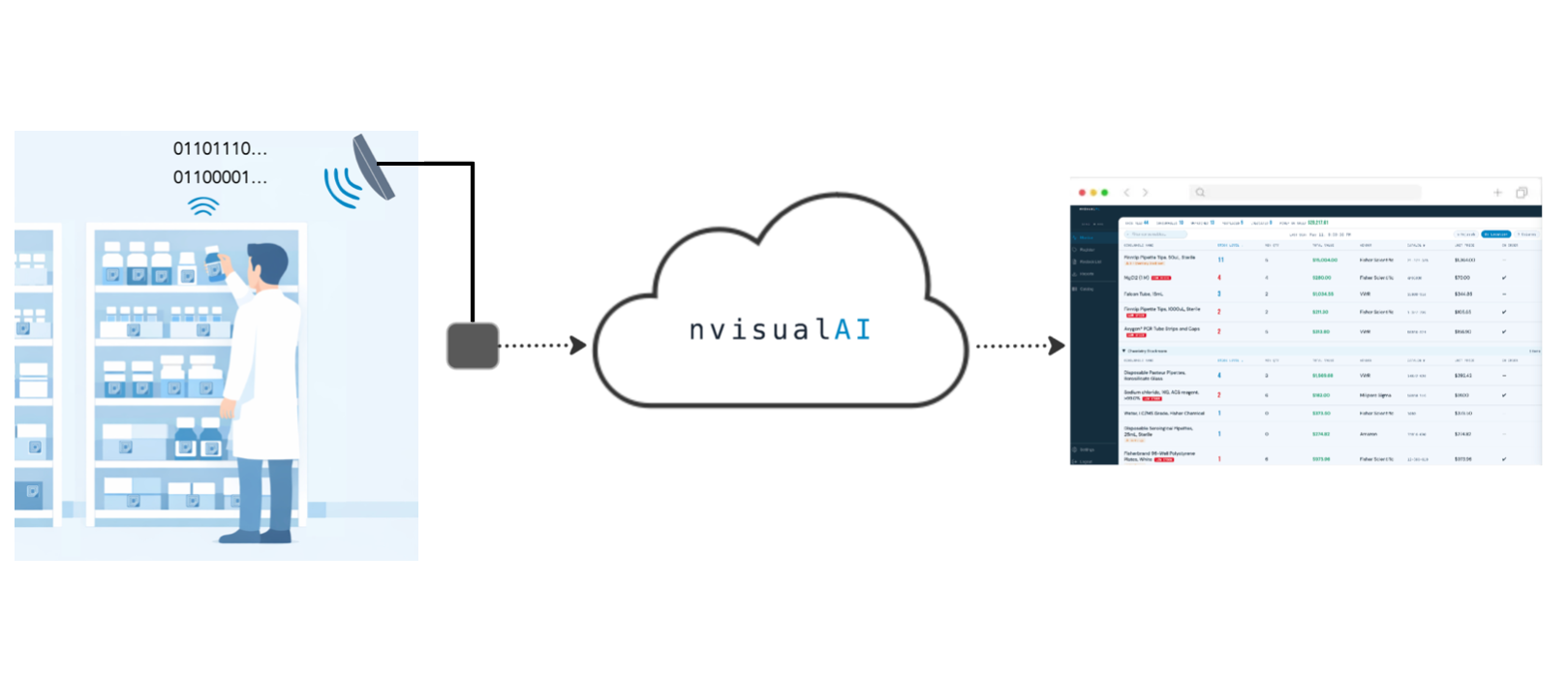
nvisualAI aims to free labs from reactive mode by giving them real-time tracking. By pairing industrial-grade RFID with purpose-built cloud software, scientists no longer have to wonder whether a material will be on the shelf when they reach for it. But eliminating manual inventory checks is a byproduct of continuous monitoring, not the point of it. The real value lies in what an uninterrupted data stream makes possible for the first time: measuring the numbers behind every reorder decision, and using them to optimize both shelf space and the capital tied up in inventory at any moment.
Solving this problem is personal for me, and something I've been building toward for over a decade. When I co-founded TetraScience 13 years ago, the life science industry was at the beginning of the cloud adoption cycle. Building a cloud-native company was considered innovative then; today, it's essential, both for adding customer value and for enabling any enterprise to reach its goals. More than a decade later, I decided to build an AI-native company for that same fundamental reason: to deliver unmatched value to the life science industry.
But how does using AI benefit our customers? For our users, it translates into four concrete advantages:
Development speed: New features are delivered in days, not months, sometimes faster.
Higher quality and reliability: Issues are detected, diagnosed, and fixed automatically by AI agents.
Lower costs: Leaner operations mean more competitive pricing and lower entry tiers.
Responsiveness: Problems get solved faster and more precisely.
AI isn't just used to offer faster development timelines, but also to enhance the data reporting accuracy, for example by accurately locating consumables when multiple RFID readers are in the same area. It will also surface meaningful insights, helping predict future shifts in demand and adjust reordering thresholds based on consumables usage trends.
All this would not have been possible without the generosity of the LabOps community who have encouraged and supported me in this effort by providing valuable guidance on the right use case to tackle and on the best way to address the inefficiencies in their labs.
Learn more about the RFID-based consumable tracking solution by visiting nvisualai.com.
nvisualAI is an AI-native technology company dedicated to modernizing laboratory inventory management. Its platform pairs industrial-grade RFID infrastructure with intelligent, cloud-based software to deliver real-time, granular visibility into laboratory consumables. nvisualAI eliminates the operational inefficiencies of manual counting, prevents costly research stockouts, and empowers life science organizations to shift capacity from administrative overhead to scientific discovery.