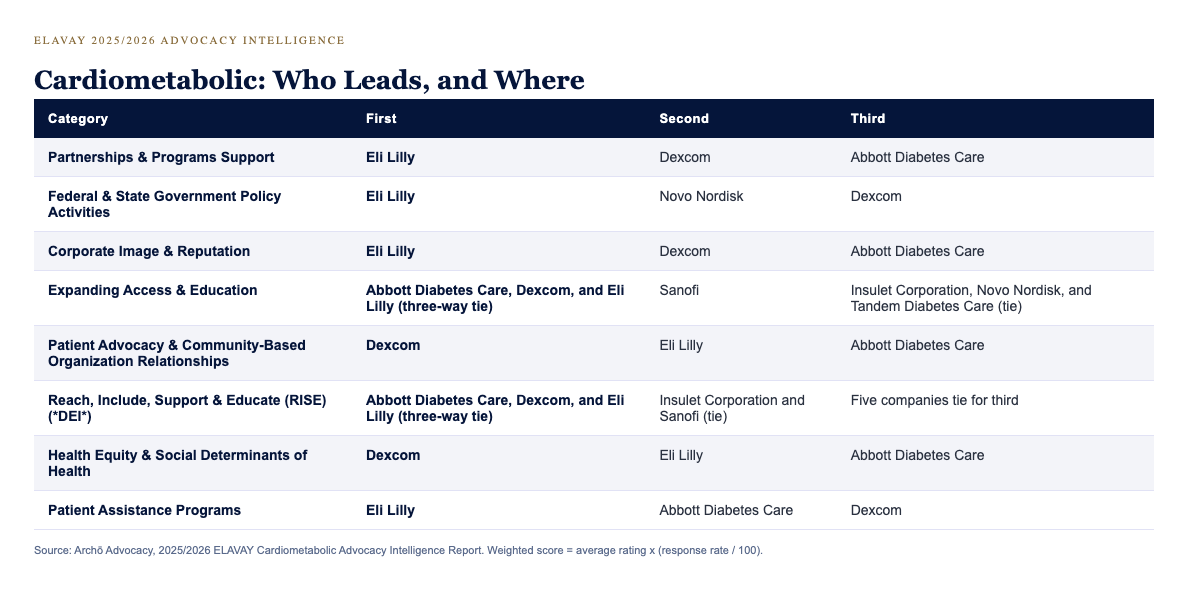


Archō Advocacy today released the 2025/2026 ELAVAY Cardiometabolic Advocacy Intelligence Report, the annual read on which companies diabetes and cardiometabolic advocates, professional societies, and community-based organizations trust to act in the patient interest. Eli Lilly finishes first, or ties for first, in six of the eight measured categories and places in the top three of every one. Dexcom finishes first in health equity and in advocacy relationships, ahead of every pharmaceutical company in the study.
Twelve companies earned mentions across the cardiometabolic field: Eli Lilly, Dexcom, Abbott Diabetes Care, Novo Nordisk, Sanofi, Insulet Corporation, Medtronic, Tandem Diabetes Care, Merck, Novartis, Genentech/Roche, and Vertex. Continuous glucose monitor and insulin pump makers share the league table with drug makers here, and they take more of the top three positions than pharma does.
“Diabetes advocates spend their days with the companies that touch the patient every day. Eli Lilly won this report by funding the work and then gett ing out of the way. Thee device companies won their positions by showing up in the community long before they needed anything,” said Matt Toresco, Founder and CEO of Archō Advocacy.
WHO LEADS, AND WHERE
Advocates ranked the companies they had worked with in the past 12 to 18 months, then rated their top three on a seven-point scale. Archō weighted recognition against rating to build each league table. Thee leaders follow, and the full report carries the scores behind them.
Corporation wins the one measure that sits outside the league tables. On the Scale of Selflessness, which asks advocates how transparent a company is about what it wants from the relationship, Insulet scores a perfect 7.00, the only perfect score in the report. Eli Lilly follows at 6.50 and Novo Nordisk at 6.00. Insulet turns that goodwill into a top-three finnish nowhere else, because too few advocates have worked with it.
Two results explain the shape of this field. Sanofi earns the highest average rating in both Partnerships and Government Policy, 6.33 and 6.13, and finishes fifth in each, because only a third of advocates named it at all. Medtronic posts a 6.00 average in Partnerships and finishes last. In cardiometabolic care, a strong relationship with a few organizations does not win a category.
THE DEVICE COMPANIES CHANGED THE TABLE
Dexcom, Abbott Diabetes Care, Insulet Corporation, Medtronic, and Tandem Diabetes Care all place in this report, and the first three outrank most of the pharmaceutical field. Dexcom finishes first in health equity contribution and first on advocacy relationships, ahead of every drug maker measured. Abbott Diabetes Care ties for first on RISE (Reach, Include, Support & Educate) recognition and holds third in Partnerships, Corporate Image, and Health Equity. No other ELAVAY therapeutic report looks like this.
Advocates explain the gap in operating terms rather than brand terms. “Dexcom has done a good job at connecting us with like-minded organizations to coordinate advocacy messaging,” one wrote. On equity, another credited the technology directly: “Dexcom is very concerned with the improvements in health that CGM offers all people with diabetes. They are leading in affordability of CGM for all.” Abbott earns credit for work the industry usually avoids: “Abbott has led a campaign on diabetes stigma which seeks to improve how people with diabetes are treated.”
Thee device field also draws the sharpest criticism in the dataset. One advocate described a sponsor relationship this way: “Constantly obscuring their pipeline, connecting funding to helping get their sales messaging amplified, strongly advocating for changes in our messaging to align with theirs.” Proximity to the patient cuts both ways.
“In diabetes, the company in the room every day is the one making the sensor or the pump. Advocates score that access honestly. Dexcom and Abbott earned rank by doing the unglamorous work, and the pharmaceutical companies that outspend them still finished behind them,” said Matt Toresco, Founder and CEO of Archō.
WHY ELI LILLY WINS: FUNDING WITHOUT A LEASH
Eli Lilly finishes first, or ties for first, in six categories and never falls below third in any measured table. Advocates describe the same behavior across those six. Thee company funds the work the organization already planned, and it does not attach the funding to its own message.
“Lilly consistently funds these initiatives with no expectation of deliverables or benefits to them commercially,” wrote one diabetes advocacy leader. Another described the working relationship: “Lilly folks ask us what they can do to help amplify our patient centered messaging including psychosocial aspects of diabetes.” A third put the reason for the reputation score plainly: “Lilly leads with kindness and empathy for patients and our members.” On access, advocates name a specific decision rather than a program: “Lilly was a leader in insulin pricing reductions and supports access and affordability in other products as well.”
CARDIOMETABOLIC ADVOCATES BREAK WITH THE FIELD ON THE IRA
Advocates in this space expect the Inflation Reduction Act to help their patients. Four in five anticipate a positive effeect, and the rest expect no effeect either way. Not one expects harm. Oncology and mental health advocates land nowhere near that position in the same study year, which makes cardiometabolic the outlier in the 2025/2026 dataset.
Thee engagement behind that view is real. More than eight in ten respondents work on healthcare policy inside their organizations, and two thirds educate their communities about the law through coalitions rather than alone. Half run federal lobbying, and half run state lobbying.
Priorities still sit closer to the exam room than to Washington. Two thirds rank disease awareness and education as the single most important challenge facing their patients, the widest first-place margin of any issue in the report. Two thirds call non-medical medication switching a high or extremely high threat, while a third report no opinion at all, a split worth watching. Half of these organizations say workforce and budget reductions across the industry have signifincantly reduced collaboration with them.
“Diabetes advocates read the Inflation Reduction Act as a win for the patients they represent, and they are the only community in this year’s study that does. Theat gap matt ers. A company running one federal policy message across every therapeutic area is gett ing it wrong in at least two of them,” Toresco said.
FROM INSIGHT TO ACTION: THE ADVOCACY INFLUENCE DIAGNOSTIC
ELAVAY measures how the outside world sees a company. Its companion tool, the Advocacy Influence Diagnostic (AID), measures how a company’s own organization sees and uses its advocacy function. AID sorts advocacy leaders into four personas, the Architect, the Defender, the Underdog, and the Whisperer, and surfaces where internal influence lags external rank.“A device company can outrank the pharmaceutical field outside and still lose the budget argument inside. AID tells advocacy leaders where their internal stance trails their external reputation, where to fix it, and how we can help at Archō,” said Toresco.
Thee full 2025/2026 ELAVAY Cardiometabolic Report carries every league table, the ratings behind each rank, and the advocate testimony in full. For the report or a private briefing on where a company sits inside the dataset, visit https://archo.io or contact Matt Toresco at [email protected].
About ELAVAY
ELAVAY turns patient and advocate insight into industry-level intelligence. By tracking how advocacy and community-based organization leaders score the companies serving their patients, ELAVAY gives healthcare organizations a clear, longitudinal read on their reputation, access position, and policy standing across the patient community.
About Archō
Archō gives patients a voice and drives positive change in healthcare. Through training, market research, and advocacy, Archō educates the industry on the value of patient-directed care and helps healthcare companies do well by doing good. Archō keeps the patient at the center of healthcare decision-making.
For more information, contact Matt Toresco, Founder & CEO, at [email protected].