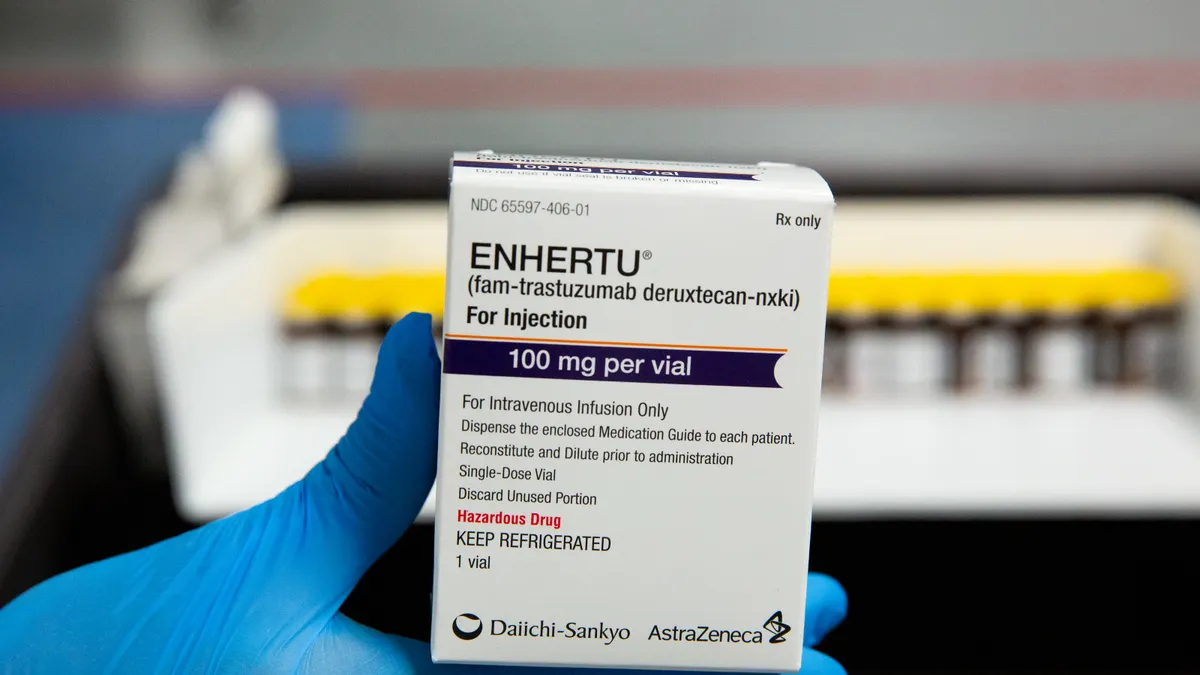
The Food and Drug Administration on Monday granted a key approval for AstraZeneca and Daiichi Sankyo’s Enhertu, clearing a regimen involving the drug as an initial treatment for HER2-positive breast cancer.
The approval issued Monday comes well ahead of the FDA’s Jan. 23 decision deadline and greenlights a combination of Enhertu and Roche’s targeted therapy Perjeta for frontline use in people whose metastatic breast cancer is confirmed to be HER2-positive by an FDA-approved test. The clearance is based on results published in the New England Journal of Medicine earlier this year, which showed the Enhertu-Perjeta regimen was more beneficial than the current first-line standard, a combination of chemotherapy and precision drugs that’s known as THP.
“With this approval of Enhertu in the first-line HER2-positive metastatic setting, Enhertu once again offers significant improvements in progression-free survival and has practice-changing potential when used in combination with pertuzumab,” said Ken Keller, global head of oncology business and president and CEO of Daiichi Sankyo, in a statement, referring to Perjeta’s biological name.
Enhertu is an antibody drug conjugate that targets the HER2 protein, which is overexpressed on multiple tumor types including 15% to 20% of breast cancers. AstraZeneca and Daiichi Sankyo began co-developing the drug in 2019 as part of a multibillion-dollar alliance and, that year, saw Enhertu receive its first approval as a third-line treatment. Enhertu has since been cleared for a few different malignancies and become a mainstay in breast cancer care, changing the way certain tumors are characterized and in some cases supplanting chemotherapy. The drug generated almost $3.8 billion in sales for 2024 and is on track to surpass that total this year.
The new approval could boost sales further still, as it positions Enhertu earlier in breast cancer care. According to AstraZeneca, about 10,000 patients in the U.S. are treated each year in the first-line setting.
Study results supporting it showed that the Enhertu-Perjeta combination lowered the risk of disease progression or death by 44% compared to THP. The treatment held tumors in check for a median of almost 41 months, versus 27 months for those receiving THP.
The side effects observed in testing were “consistent” with the profiles of the individual medicines, with “no new safety concerns identified,” AstraZeneca said in a statement. But among those side effects for Enhertu are potentially serious lung complications. Called interstitial lung disease and pneumonitis, they’re already part of a safety warning on Enhertu’s labeling and were observed in 46 treated participants — including two deaths — in AstraZeneca and Daiichi Sankyo’s study. Only four cases occurred in those who received THP. The Phase 3 study enrolled 1,157 participants.
Daiichi Sankyo will receive a $150 million milestone payment from AstraZeneca as a result of Monday’s approval.