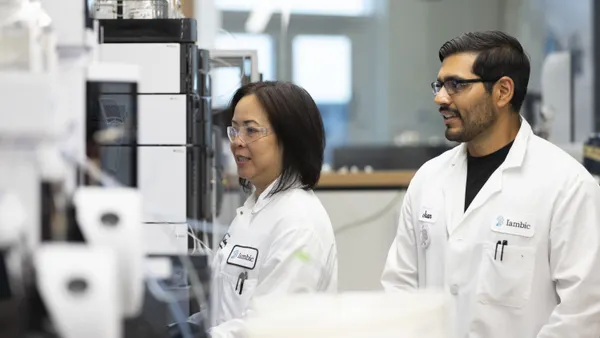
Gilead Sciences is deepening its investment in cell therapy, agreeing on Monday to acquire its longtime development partner Arcellx in a $7.8 billion deal centered around an experimental multiple myeloma treatment.
Gilead already owned about 11.5% of Arcellx’s equity prior to the deal’s announcement. It will now pay $115 per share for the rest of Arcellx’s stock, representing a roughly 79% premium to the company’s closing price on Friday. Arcellx stockholders could receive another $5 per share in future payouts, too, should the biotech’s top program, “anito-cel,” win approval and go on to generate $6 billion in cumulative net sales through the end of 2029.
The deal is expected to close during the second quarter.
Gilead is best known for its HIV drugs. But it’s also long been a leader in cancer cell therapy, a way of modifying the body’s immune defenders to hunt and kill tumors. Through its $12 billion acquisition of Kite Pharma nearly a decade ago, the company acquired two blood cancer therapies now known as Yescarta and Tecartus. Those therapies are the centerpiece of a business that now brings in more than $1 billion annually and that Gilead has looked to as a way to diversify into oncology.
Still, Gilead’s cell therapy business took years to ramp up, part of a broader struggle companies have had profitably selling complex treatments that take weeks to make and are largely administered at major institutions. And of late, sales have declined amid pressure from newer competitors. In its latest earnings report last month, Gilead said overall cell therapy sales fell 7% in 2025 and predicted they’ll slide by another 10% in 2026.
Yet Gilead sees anito-cel potentially turning that business around. Arcellx medicine imbues T cells with the ability to fight multiple myeloma, a progressive cancer of the bone marrow. That therapy has already been submitted for U.S. approval based on study results showing a 96% response rate among recipients whose multiple myeloma had relapsed, or hadn’t responded to, at least three prior treatments. A decision is expected by Dec. 23.
Effective, marketed cell therapies from Johnson & Johnson and Bristol Myers Squibb work similarly, as do a handful of “bispecific” antibody therapies. Gilead, for its part, said in a statement that anito-cel has demonstrated “deep and durable responses” with a “predictable and manageable safety profile,” which addresses “key challenges” associated with existing multiple myeloma cell therapies. The companies have been aiming to prove, for instance, that people who receive anito-cel have a lower risk of a cell therapy-related side effect called parkinsonism.
Antio cel “could become a foundational treatment for multiple myeloma over time, including earlier lines of therapy,” said CEO Daniel O’Day, in the statement.
The therapy has “shown generally comparable efficacy” to Carvykti with the potential for a better safety, wrote RBC Capital Markets analyst Brian Abrahams, in a Monday note to clients. But Gilead and Arcellx are behind competitors in an area “where early entrenchment may be important. The “degree of market acceptance” for a cell therapy in the earliest lines of care is also “unclear,” he added.
Like some of its peers, Gilead has also invested in “in vivo” treatments that modify cells inside the body and are seen as more convenient alternatives to existing therapies. Gilead claimed that some Arcellx research could be useful there, in addition to helping produce “next-generation” cell therapies and bispecific antibodies.
Arcellx went public in February 2022 at $15 per share. It began working with Gilead several months later and expanded the collaboration in 2023. That alliance gave Gilead partial rights in the U.S. and full ownership elsewhere.