Dive Brief:
- Kailera said Wednesday its triple-acting obesity shot spurred double-digit weight loss in a short Phase 1 dosing trial conducted in China by partner Hengrui Pharmaceuticals, with investigators reporting that enrollees lost up to 16% of their body weight over 12 weeks.
- The data compare favorably to early-stage data reported by Zepbound maker Eli Lilly with its so-called “triple-G” agonist drug, which hadn’t reached 10% at the 12-week time point, wrote T.D. Cowen analyst Yaron Werber. Kailera is readying its own Phase 1 trial outside China, which will have data in 2027, while Hengrui is advancing the drug into Phase 2 in China.
- Data from the triple-G drug, called KAI-4729, follows positive mid-stage data for Kailera and Hengrui’s dual-acting Zepbound competitor, which has already entered a Phase 3 study. The rapid advancement of Kailera’s pipeline licensed from Hengrui has driven investor enthusiasm for the company and allowed it to enter the publicly traded markets with one of biotech’s largest-ever initial public offerings.
Dive Insight:
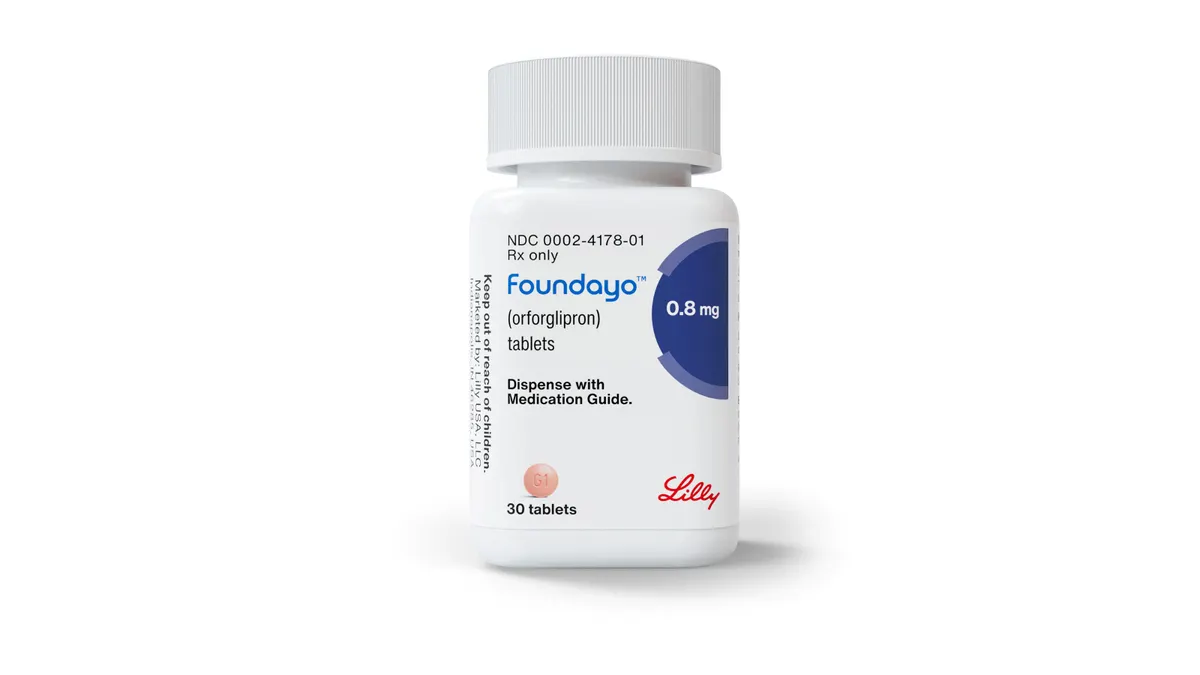
Kailera is one of dozens of companies developing obesity drugs in the hope that they can crack through Lilly and Novo Nordisk’s formidable franchises fortified by the incretin stimulating drugs Zepbound, Wegovy and Foundayo. Those who succeed could grab a share of a market that some analysts estimate will exceed $100 billion a year.
Supported by its $625 million IPO, a haul that will fund it through 2028, Kailera is one of the most closely watched. It chose to take advantage of China’s less-restrictive regulatory structure for drug discovery by in-licensing four assets from Hengrui, which include the lead drug ribupatide. The four drugs have a backbone of a GLP-1 stimulating drug, the main channel of Novo’s drug Wegovy, and ribupatide adds GIP to the mix, similar to Zepbound.
Along with GLP-1 and GIP, KAI-4729 simulates another gut hormone called glucagon, similar to Lilly’s retatrutide, the most-advanced triple-G drug. In a Phase 3 trial, retatrutide helped people with obesity lose up to 28% of their body weight when taken over 80 weeks.
The data for KAI-4729 came from a Phase 1 trial that tested steadily increasing doses to evaluate side effects as well as determine the best one to advance into pivotal trials. In a group of 12 enrollees who started at a 2 milligram weekly dose and escalated to 12 milligrams by 12 weeks, the weight loss was 16%, Kailera said.
The trial included ribupatide as an active control as well as a placebo. People who got the placebo lost 5% of their body weight, a high rate compared to most trials of obesity drugs.
Kailera said the drug demonstrated “favorable safety and tolerability data consistent with GLP-1-based treatments,” with mild to moderate gastrointestinal side effects.
This result “is a highly encouraging early signal and consistent with the preclinical thesis that ’4729 is a step up in potency vs retatrutide,” wrote Werber in a note to clients.