Dive Brief:
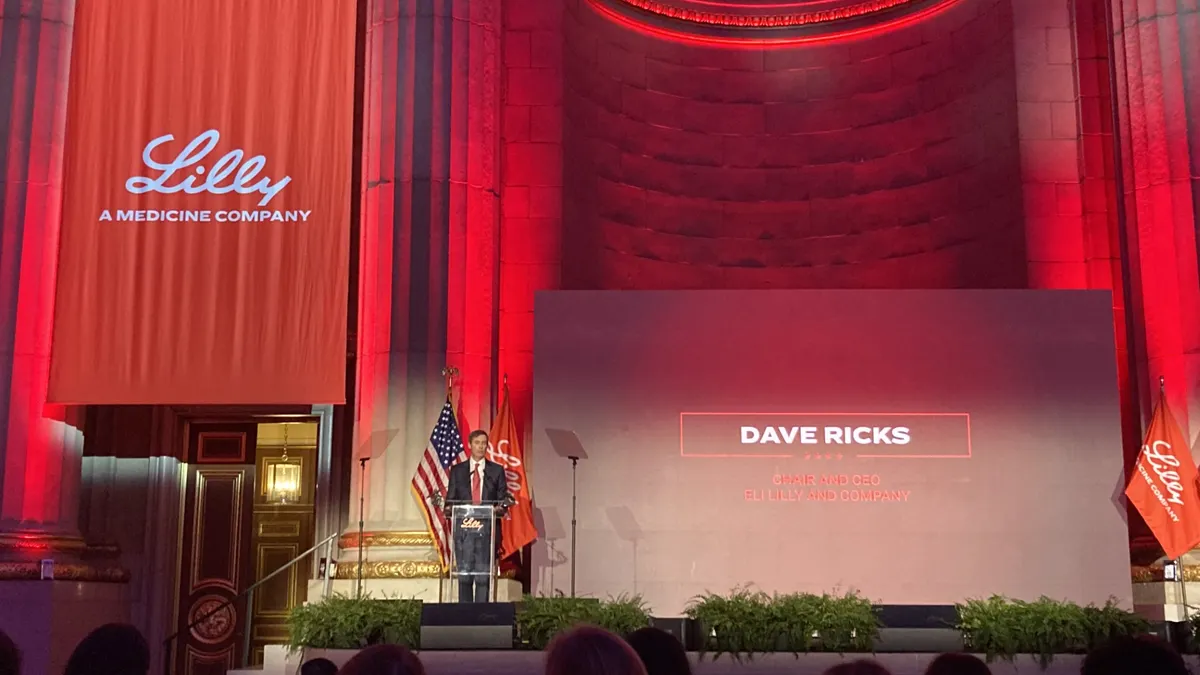
- Eli Lilly is spending $6.3 billion to buy London-based Centessa Pharmaceuticals, betting on a portfolio of neuroscience medicines that could be part of the next big drug class in sleep disorders, the company said Tuesday.
- Per deal terms, Lilly will pay Centessa shareholders $38 a share, or roughly a 41% premium on the average trading price in the past 30 days. The pharmaceutical giant will offer up to an additional $9 a share to Centessa via a contingent value right based on Food and Drug Administration approvals of either of its two drugs in narcolepsy or related disorders, adding another potential $1.5 billion to the deal value.
- Centessa has two drugs in clinical-stage testing that stimulate a brain protein called OX2R, which promotes wakefulness. Their potential to transform treatment of sleep disorders like narcolepsy has other developers like Takeda, Eisai and Alkermes racing to get OX2R drugs to the market.
Dive Insight:
Flush with cash from its obesity franchise and boosted by a valuation that briefly ticked over the trillion-dollar mark late last year, Lilly has been a prolific dealmaker and committed billions to manufacturing in the U.S. and overseas. Several deals this year have focused on strengthening its pipeline of immune system drugs, such as the $1.2 billion buyout of Ventyx Biosciences, although it has also looked to nerve-related conditions like hearing loss.
Acquiring Centessa addresses a blind spot in Lilly’s neuroscience research — sleep disorders — which RBC Capital Markets analyst Brian Abrahams calls a “nearly commercial, multi-billion dollar” market. The race to bring to market drugs targeting OX2R, or orexin receptor 2, is led by Takeda’s , which is due an FDA decision on its medicine oveporexton in narcolepsy type 1 sometime in the third quarter.
With the Centessa buyout, Lilly puts itself in a position to compete. “Despite growing CNS exposure across depression, pain and neurodegeneration, [Lilly] has lacked a credible insomnia position — a high-unmet-need category where orexin biology is driving differentiation,” Abrahams wrote in a note to clients.
Centessa’s lead drug is called cleminorexton, or ORX750, which has Phase 2 data in two types of narcolepsy and idiopathic hypersomnia, with the start of pivotal trials expected soon. A second drug called ORX142 has completed Phase 1 studies in healthy people, and testing in patients is due to begin soon.
Once-a-day dosing could help Centessa’s drug combat the first-mover advantage of Takeda, whose offering is taken twice a day. Abrahams wrote that a sleep disorder specialist he consulted suggested less frequent dosing would be preferable to aid compliance and tolerability, “while efficacy was not a key driver of drug selection.”
The buyout helped boost shares of Alkermes by 18% in morning trading. The biotech has a drug at roughly the same point in development as Centessa, making it a potential buyout target.
“While some may say that this deal for [Centessa] validates that their molecule may be best-in-class, we think it's far too soon to call a winner, and more likely the [total market] for the category is bigger than investors are crediting — with room for multiple players,” wrote Stifel analyst Paul Matteis.