Today, a brief rundown of news from Praxis Precision Medicines and Bristol Myers Squibb, as well as updates from Denali Therapeutics, Crescent Biopharma and AstraZeneca that you may have missed.
Shares of Praxis Precision Medicines surged roughly 40% Friday, on news the company and the Food and Drug Administration are aligned on what should be included in an approval application for an experimental medicine known as ulixacaltamide. Praxis now expects to file for approval early next year. A longshot bet on this medicine began to pay off in October, when Praxis disclosed that two late-stage studies testing it against “essential tremor” had hit their main goals. The company’s stock price more than tripled after the announcement, cresting around $200. Praxis also said Friday it stopped early, for overwhelming efficacy, a study of a different drug being tested in types of childhood encephalopathies. Shares traded at $266 apiece mid-Friday morning. — Jacob Bell
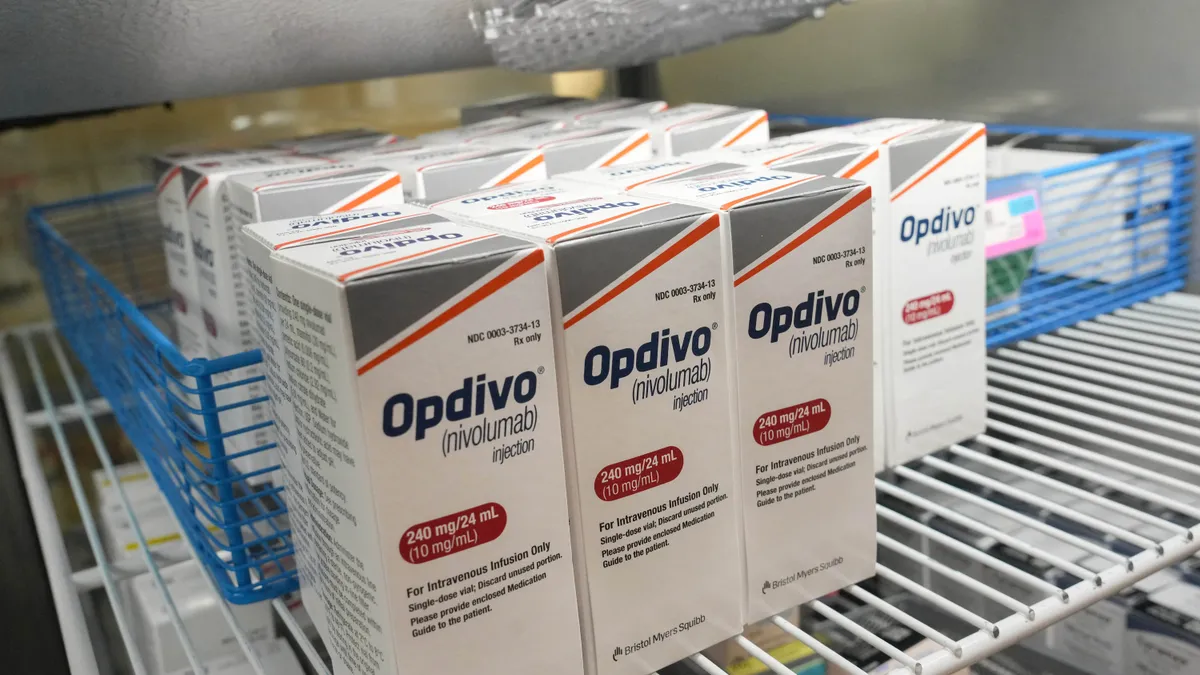
The FDA has broadened use of Bristol Myers Squibb's Breyanzi, clearing it on Thursday for use treating certain relapsed or refractory cases of marginal zone lymphoma. The new approval makes Breyanzi the first cell therapy available for the rare, slow-growing lymphatic tumor, which is believed to account for about 7% of all B-cell non-Hodgkin lymphoma cases, according ot the FDA. It's also the fifth different indication for Breyanzi, a cellular medicine Bristol Myers inherited through its acquisition of Celgene. Breyanzi generated $747 million in sales in 2024 and $966 million over the first nine months of 2025. — Ben Fidler
Denali Therapeutics may receive up to $275 million through a new deal that revolves around the company’s most advanced drug. Known scientifically as tividenofusp alfa, the medicine is currently under FDA review, with an approval deadline of April 5. Denali has now agreed to pay a 9.25% royalty on worldwide net sales of tividenofusp alfa to Royalty Pharma. In exchange, Royalty will hand over $200 million up front, plus another $75 million if the treatment gets cleared for use in the European Union by the end of the decade. The agreement still hinges on Denali’s drug securing U.S. approval. Additionally, the royalty payments would stop if the earnings reach either a 3-times multiple, or a 2.5-times multiple by the first quarter of 2039. — Jacob Bell
Crescent Biopharma and China-based Kelun Biotech have formed an alliance that will see the two companies acquire partial rights to each others' cancer drugs and test them in combinations. Through the deal, Crescent has granted Kelun rights in Greater China to an experimental cancer immunotherapy targeting the proteins PD-1 and VEGF. Kelun, meanwhile, will hand Crescent most rights outside of Greater China to an experimental antibody-drug conjugate aimed at a target known as integrin beta-6. Both medicines are being developed for solid tumors and are in preclinical testing, with human studies expected to begin next year. Kelun will receive $80 million upfront from Crescent, while Crescent will pocket $20 million. — Ben Fidler
Neurimmune broadened an existing partnership with AstraZeneca, agreeing on Thursday to license to the British drugmaker rights to a preclinical prospect for amyloid light chain — or “AL” — amyloidosis. The Swiss biotech will receive an undisclosed upfront payment and is eligible for as much as $780 million in future payouts, should the therapy hit a series of development, regulatory and sales targets. Neurimmune and AstraZeneca first joined forces in 2022 to develop a treatment for transthyretin amyloidosis cardiomyopathy. That drug is now in late-stage testing. — Ben Fidler