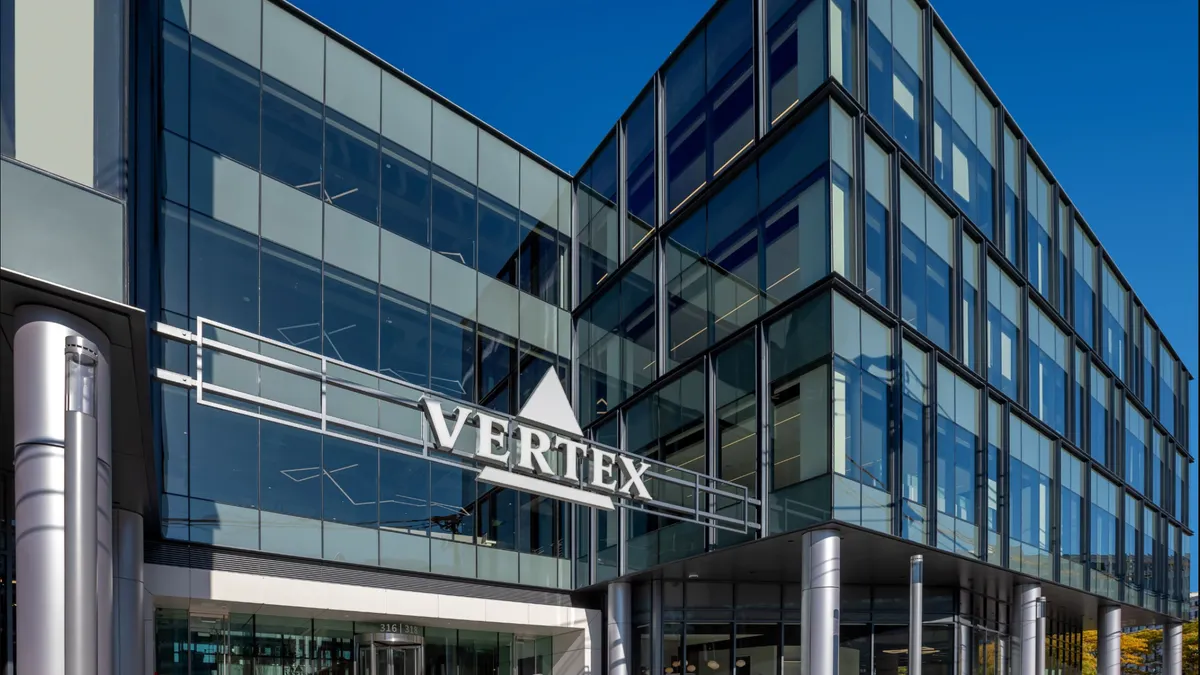
Shares of Vertex Pharmaceuticals were little changed late Monday after the Boston-based biotechnology company reported its latest round of earnings.
Vertex, which has ballooned to a roughly $110 billion value thanks to the market success of its cystic fibrosis medicines, recorded $3 billion in revenue across the first three months of the year. That total was just shy of Wall Street estimates, according to Evercore ISI analyst Cory Kasimov.
The lion’s share of revenue again came from Trikafta, a three-in-one oral therapy that was approved in 2019 and has the potential to work in approximately 90% of cystic fibrosis patients. It generated $2.35 billion in the quarter, down 7% from the same period a year prior. Meanwhile, revenue from a successor drug called Alyftrek grew eightfold, to $424 million, which Kasimov argued “may potentially signal a healthy switch rate.”
Vertex’s other products include Casgevy, a gene editing therapy for sickle cell disease and another blood disorder, and Journavx, a first-of-its-kind, non-opioid drug for pain. The company touted how the launches for both are progressing.
Infusions of Casgevy are increasing, for example, and an application was just submitted to get the therapy approved in the U.S. for younger children. With Journavx, total prescriptions recently surpassed the 1 million mark. The drug also just got added to a list of non-opioid pain medications that Medicare is trying to make easier to access and afford for older Americans.
In spite of those developments, Casgevy and Journavx respectively brought in $43 million and $29 million during the quarter, figures that were around 10% and 18% below average analyst estimates. Journavx is currently used for the short-lived “acute” pain that follows an accident or surgery. Analysts have said they don’t expect sales to significantly grow until it gets cleared to treat chronic pain.
Vertex shares were subsequently down 1% in after-hours trading Monday.
Investors have been paying particular attention to one of Vertex’s experimental medicines, povetacicept, which is designed to block two proteins that trigger immune system responses. Vertex very recently submitted povetacicept for regulatory review, for the treatment of a kidney illness known as IgA nephropathy. The drug is also in testing for a rare autoimmune disorder that affects the nerves and muscles.
According to RBC Capital Markets analyst Brian Abrahams, another Vertex drug, inaxaplin, is in “higher focus” following clinical trial results from a rival developer. Interim data from a later-stage study of inaxaplin are now slated for early 2027, and should provide a more definitive look at whether it can help people with kidney disease caused by mutations in a gene named APOL1.
“Despite a few minor shortfalls, overall a reasonably in-line quarter and likely better than some had feared going in, which we believe should set the company up solidly into upcoming data and regulatory catalysts,” Abrahams wrote in a note to clients.