
Some of the most consequential conversations we have with life sciences clients start with a request that does not have an obvious answer. It might mean adapting an existing structure that was never intended to support a life sciences facility, incorporating a material that would not typically be considered for this environment, fitting process equipment into a building that was never designed for it or completing critical work around operations that cannot stop.
The scale of the project does not always reflect its complexity. A tightly contained renovation inside an operating facility can carry more execution risk than a much larger new build. The challenge may involve an active utility system or a fixed shutdown window. In other cases, it requires the team to rethink something much more fundamental about the way the facility will be built.
Any of these situations may impact a project’s goal if solutions are not developed early. For a manufacturer, this could mean a missed production window or capacity that is unavailable when the business needs it. In a research environment, it can disrupt studies that depend on continuity.
For life sciences owners, these challenges demand a technical builder with the field experience and technical depth to work through constraints the team may not have seen before.
When ‘impossible’ is really an unresolved constraint
At DPR Construction, we recently saw this with a long-time client pursuing an ambitious sustainability goal that called for using wood in and around a manufacturing environment, a material not typically considered for this type of facility.
The team’s first reaction was hesitation. How will we incorporate material into an environment where we have been trained for years to treat it a certain way. We had to think about cleanability, operations and long-term performance to make it work.
That was the point. The client trusted us with an idea that challenged convention. It took technical depth, curiosity and a willingness to question what had always been done. Our job was to understand the risks and find a way to make it work in operation.
The same thinking applies to less unusual challenges. Equipment, utilities, structure, quality requirements and field conditions are all connected. On a complex project, different people may have insight into different aspects of the solution. The builder has to understand those connections well enough to help the team focus on what is actually driving execution.
Getting the right people involved early
There is a lot riding on these decisions. EY reported in its 2026 Biotech Beyond Borders report that industry leaders have pledged upward of $370 billion toward U.S. manufacturing as companies respond to changing trade conditions and look for more resilient supply strategies.
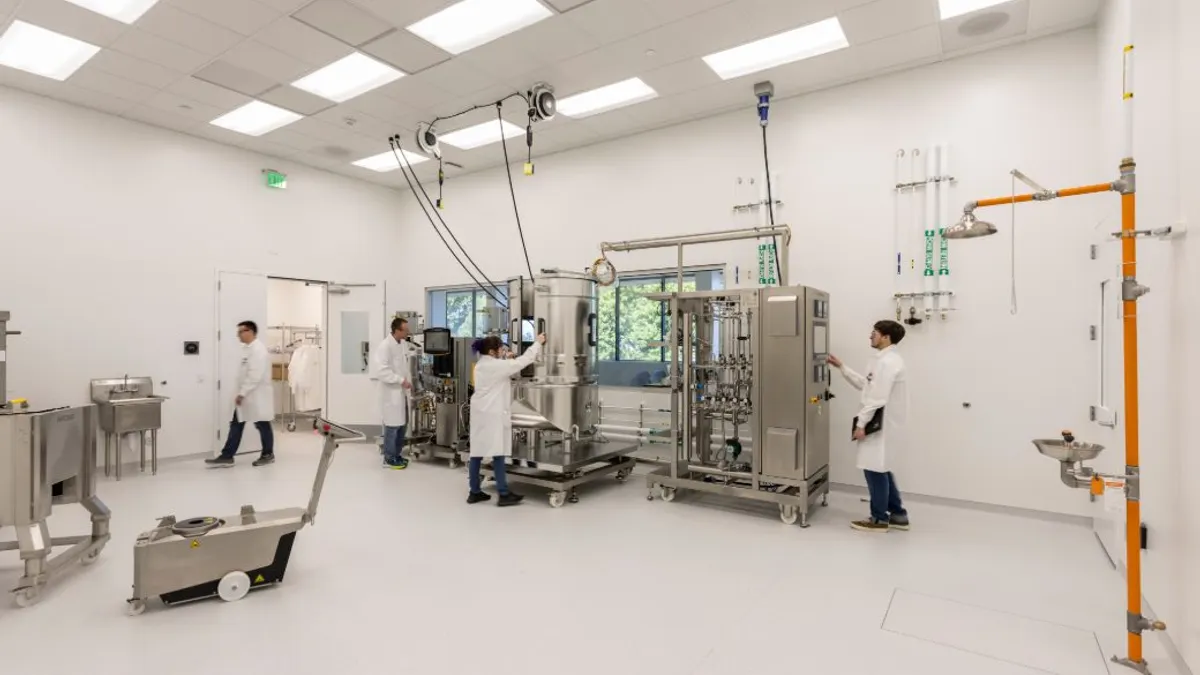
On a biomanufacturing project, something as basic as confirming a vendor’s equipment dimensions and utility requirements can affect structural loading, MEP routing and even how the equipment will get into the building. If that information arrives late, the team may be forced to solve in the field what could have been more efficiently and effectively handled during planning.
Integrated delivery methods help keep those conversations connected. Designers, trade partners, equipment vendors, facilities teams and builders can work through the implications as the design develops rather than handing information from one group to the next as the project unfolds.
Field knowledge also needs to be part of that process. With self-perform capability, here is a direct connection to how work will be staffed and installed. Labor assumptions can be tested against what teams are seeing in the market. Constructability questions can be discussed with people who understand the installation. If the original approach needs to change, there is more information available to make that decision.
The value is in getting these types of questions and possible solutions into the conversation early enough to shape the plan from the outset.
Why life sciences demands a different standard
Life sciences facilities carry a layer of risk that most other building types don’t: the construction itself can compromise the product. Airflow, pressure relationships and surface materials aren’t just performance considerations, they’re contamination control points, and construction activity has the ability to affect all three.
That’s part of what made the wood decision mentioned earlier so complicated. Wood is porous, it interacts with humidity, and in most manufacturing contexts it raises immediate questions about cleanability and microbial risk, questions that don’t come up the same way with steel or concrete. Solving for that required more than a structural engineer; it required people who understood how a material behaves under the same quality and regulatory scrutiny as the product being manufactured.
In an operating cGMP environment, the construction team also needs to understand the facility’s quality requirements as well as its physical ones. Planning may include clean-build protocols, contamination controls, temporary utilities, equipment interfaces and shutdowns, each one connected to a validated process that can’t be compromised without consequences far beyond the construction schedule. Facilities, quality and operations teams often need to be part of these decisions because they know what can be interrupted and what must remain protected.
A shutdown that looks manageable on a schedule can be much more complicated once you understand the systems it touches. A utility tie-in can have implications well beyond the room where the work takes place.
This is where life sciences experience matters most: understanding that every material and sequencing decision carries regulatory weight, not just a schedule or budget one.
The work also needs to support what comes next. Construction helps position the facility for commissioning, qualification and validation, while the owner retains responsibility for its process, quality systems and regulatory obligations. A good construction plan considers this handoff from the beginning.
Building for the next challenge
Turnover is only one point in the life of a facility. Equipment will change. Processes will evolve. A client may come back with a small renovation that carries just as much operational risk as the original capital project.
Over time, the project team builds knowledge and experience that is difficult to recreate from drawings alone. They understand how this and other similar sites operate, where the sensitive systems are and how life sciences customers make decisions.
This is the kind of relationship DPR Construction builds with clients over time. When the next constraint or outside the box idea comes up, there is already enough trust to put the hard idea on the table and work through it together.
The next challenge may look completely different from the last one. It may even sound impossible at first. With the right people, the right technical experience and a clear understanding of how the facility actually operates, the real problem-solving can begin.