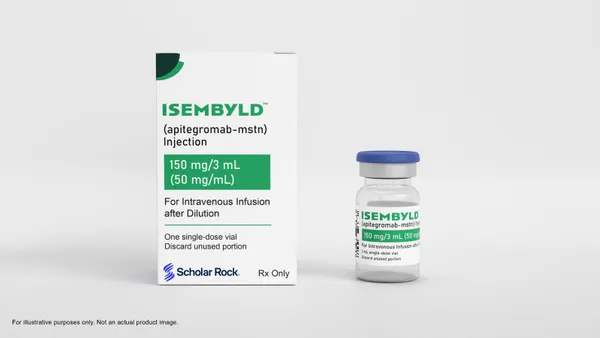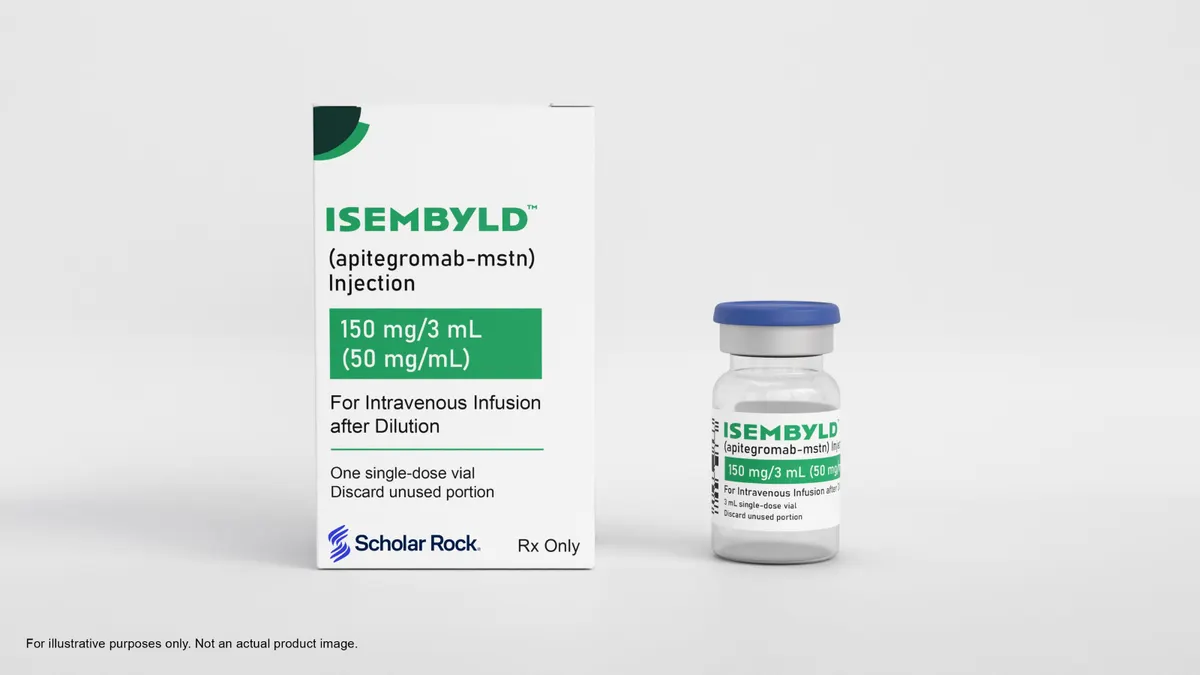
The Food and Drug Administration has approved a new kind of medication for the rare genetic disease spinal muscular atrophy.
Called apitegromab and to be sold as Isembyld, the treatment on Friday was cleared for use alongside existing targeted therapies in adults with SMA as well as children at least 2 years of age. For a typical SMA patient, the drug will have an annual list price of about $310,000 per year, executives revealed on a Monday conference call. Costs will vary person-to-person based on a patient’s weight and insurance coverage.
Isembyld’s clearance will once again change the treatment landscape for a potentially lethal disease that had no approved medicines as recently as a decade ago.
SMA is an inherited condition that causes progressive weakness and is typically fatal in its most severe form, which affects infants. It’s one of the most common rare diseases and is believed to impact as many as 10,000 to 25,000 children and adults in the U.S., according to the non-profit SMA foundation.
Prior to 2016, there weren’t any treatments available that could change the course of SMA. Medical care was more focused on supportive therapy and symptom management. Since then, though, the FDA has approved a gene-targeting drug from Biogen, a one-time gene therapy from Novartis and an oral medication from Roche. All three can keep babies alive when they might have died otherwise, grow healthily and avoid using a machine to help them breathe.
Still, those three drugs have mixed effects on motor function, leading to an eventual decline and providing room for a therapy that can alter that outcome. Isembyld could become that option. The drug blocks a protein, myostatin, that limits muscle growth. When tested alongside standard therapy, Isembyld showed it could significantly improve motor function compared to typical care alone.
Scholar Rock’s findings in late 2024 caused its share price, which had hovered around $10 apiece for multiple years, to take off. The company then overhauled its management team, built a sales force and prepped for a launch. Its new leaders made clear Scholar Rock’s intentions to grow into a large, independent company. Analysts at the firm Leerink Partners have predicted that Isembyld could bring in around $2 billion in peak annual sales
Yet Isembyld’s clearance has been held up by issues observed at a manufacturing facility that conducts “fill-finish” services for the company. Those problems led the FDA to reject Isembyld last September and for Scholar Rock to spend much of the last year coming up with an alternative production plan. In August, for instance, the company removed that facility from its application and added an alternate plant that met FDA standards. That change forced Scholar Rock to submit a new request in Europe, too.
That plan has now paid off with the company’s first drug approval. In its statement, Scholar Rock referred to Isembyld as the first “muscle-targeted” treatment for SMA and a “therapeutic breakthrough.” And Kenneth Hobby, the president of the advocacy group Cure SMA, noted in the statement that the clearance grants access to a “broad population” of people with the disease.
Improving motor function “is a significant unmet need that must be addressed with urgency,” Hobby said in Scholar Rock’s statement.
The prescribing information included a warning that Isembyld might increase the risk of bone fractures. That warning was “unexpected,” as fractures hadn’t previously been disclosed, wrote Leerink Partners analyst Basma Radwan. Still, they didn’t lead any participants to stop treatment and affected patients with “pre-existing risk factors,” she wrote.
Upper respiratory tract infections, vomiting, viral infections and headaches were among the other side effects linked to treatment.
Scholar Rock was awarded a “priority review” voucher that can speed up drug evaluations. Those vouchers can also be sold for nine-figure sums.