After surging to record levels in 2024, venture investments in women’s health companies plummeted last year. Some industry watchers think a shift in the way entrepreneurs and startups are marketing themselves could spark a more sustainable rebound.
A recent report from Silicon Valley Bank, a division of First Citizens Bank that tracks startup funding, put the situation in context. In that report, SVB found that the total venture funding flowing into women’s health companies — which include makers of therapeutics, devices and health technologies — plummeted from $3.2 billion in 2024 to around $2 billion in 2025. The percentage of healthcare venture deals these companies were involved in fell from 7.4% to 5.7% over that timeframe.
Biopharma startups were hit particularly hard, with venture funding numbers plunging from $1.3 billion to $610 million, according to the SVB report.
The report’s authors argued that women’s health companies were swept up in a broader change across the healthcare ecosystem. Investors have increasingly turned their attention to more established companies that seem to be surer bets.
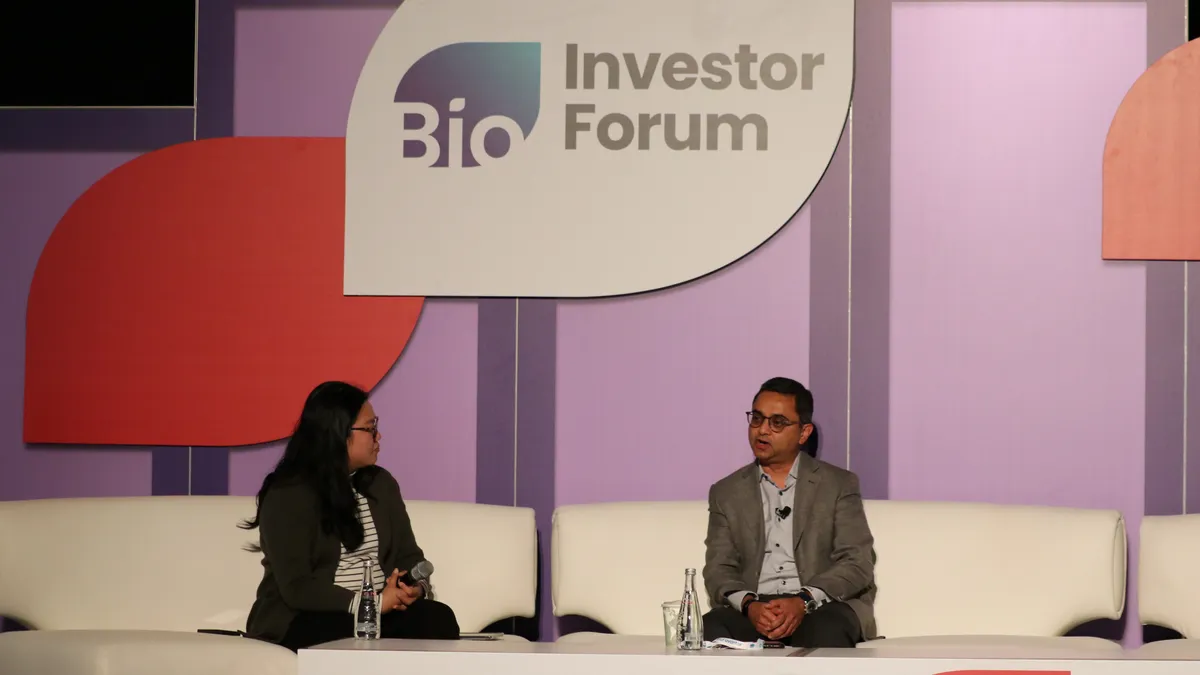
“There's a shift in healthcare investing as a whole,” said Megan Scheffel, head of life sciences and healthcare for SVB, in an interview with BioPharma Dive.
The ripple effects are being felt by women's health startups, Scheffel said. Young companies need to prove far more than they previously did, with founders needing to “gain tangible early traction” to secure early funding. Fewer companies are meeting that bar, leading less and less to graduate to their next round. SVB determined that, as a result, investors have been pouring smaller amounts into earlier-stage companies.
“I think [companies] would like to raise big rounds; at the same time, you have to be able to do more with those rounds,” she said.
Those companies are also competing with AI-centric startups that are “sucking up a lot of the air in the room,” Payal Divakaran, of investment firm .406 Ventures, said in the report. AI drug discovery investments are lifting venture funding totals in the biopharmaceutical space, but women’s health companies aren’t yet capitalizing the way the rest of healthcare is.
Scheffel refers to these series of shifts as a “reset” that’s recalibrating “where and how capital moves through the market.”
“While initial capital remains available, the baseline to secure it has shifted dramatically,” she said. “Progress that used to be the province of Series A is now required to raise a Seed round.”
“The fundraising is down, the valuations are different, and so [companies are] doing more with less,” she added.
They’re also marketing themselves differently, she and others say.
When Scheffel’s team began tracking women’s health investments a few years ago, the venture deals they saw were primarily focused on reproductive healthcare, a term encompassing contraception, maternal health issues and fertility. Drug development there and for other conditions primarily affecting women has been historically underfunded, as longstanding research gaps have made for difficult investment propositions.
“Women's health is a category that, to some extent, has been out of favor with traditional biotech investors,” said Douglas Tsao, a senior analyst and managing director at investment firm H.C. Wainwright.
Some recent drug products tailored to women have not been “commercially successful” either, Tsao added.
Veozah, a non-hormonal therapy Astellas Pharma developed for menopause, launched in 2023 and struggled to take off following its 2023 launch due to a lack of demand and reimbursement obstacles. Sales reached about $300 million last year and totaled close to $100 million in the first fiscal quarter of 2026. Bayer hasn’t yet broken out sales for a competing drug, Lynkuet, approved last year.
According to Scheffel, women’s health companies are now changing their investment pitches. The “addressable market” they’re chasing is bigger, involving conditions like depression, obesity or heart disease that affect both women and men — but impact women differently, disproportionately or uniquely.
“People don’t come out and say I’m serving women, because they’re not only serving women, they’re serving men and women,” Scheffel said. “It’s like a marketing issue more than it is anything else.”
Some investors have been rewarded for betting on those kinds of companies. SVB’s report noted how 18 women’s health companies were acquired in 2025, a small dip from the 21 purchases a year prior. In a particularly active 2026 for biopharmaceutical dealmaking, one of the year’s largest buyouts involved a women’s health company, Organon.
Notably, 14 women’s health startups went public in 2025 after zero did in 2024. And more “unicorns” worth at least a billion dollars — among them Flo Health, Midi Health and Maven — are emerging, too, according to SVB.
Tsao notes that some of this activity is concentrated around “low barrier to entry” aspects of women’s health, such as diagnostics or testing services that can be brought to market more quickly and cheaply than a new medicine.
Companies could accelerate investment further by adopting AI more, Scheffel said.
A Pew Research Center poll cited in SVB’s report illustrated that women are less likely than men to believe AI can improve their healthcare. But Scheffel pointed out that many women’s health companies are compiling troves of data on women who are pregnant or undergoing menopause. That information could be useful in unearthing future treatments for underserved conditions.
“There’s a pretty big opportunity for change,” Scheffel said.