Seven years ago, when Johnson & Johnson brought a new, ketamine-based depression treatment to market, there were relatively few specialized psychiatry clinics that had the space, staff and expertise necessary to administer the drug.
Catherine Owen-Adams, a former president in J&J’s Janssen division, described the landscape as “very underdeveloped” and requiring a “huge investment” when Spravato launched. But that investment appears to have paid off. Spravato printed more than $1 billion in the first half of this year. And there are now thousands of so-called interventional psychiatry clinics across the U.S.
Those clinics may soon serve as the test beds for a wave of psychedelic therapies speeding toward the market. The most advanced among them is “COMP360,” a synthetic form of a hallucination-inducing compound found in certain mushroom species. The drug’s developer, U.K.-based Compass Pathways, has been gradually submitting an approval application with U.S. regulators, and expects to complete the filing sometime in the fourth quarter.
Compass CEO Kabir Nath and Chief Patient Officer Steve Levine recently spoke with BioPharma Dive about how their launch plans are progressing and the helpful precedent Spravato has set. They also offered thoughts on the competitive landscape with other psychedelics biotechs, and whether COMP360 might run into the same sales obstacles as a couple other new nervous system medicines.
The following conversation has been edited and condensed for clarity.
BIOPHARMA DIVE: How are you going to roll out COMP360? Is there adequate infrastructure from a healthcare setting perspective? Your drug is administered over a six- to eight-hour observation period. It’s hard to imagine that at most doctors’ offices, which are so strapped for time and resources.
LEVINE: If we were counting on the places where the bulk of antidepressants are written, which is in primary care, then you're exactly right. Those are overrun, busy, few-minute visit clinical situations where yes, this would not fit.
In 2019, when Spravato launched, there were just a small handful of interventional psychiatry clinics that could handle in-office multi-hour observation. Fast forward to today, there are about 8,500. And within those 8,500, there's a lot of capacity.
There's capacity for at least two reasons. Number one: they're not there to be Spravato clinics; they're there to be interventional psychiatry practices, and they're anticipating approvals to come. And so they've built capacity ahead. Number two: Spravato is a tough treatment to sign up for. It's 25- to 50 day-long treatments per year. No, it doesn't take the entire day; it's about a three-hour visit. But for a patient, a day is a day.
So the infrastructure is ready and waiting. The same clinical staff will monitor patients having our treatment as are in these centers today. It's a team-based model. There's a multidisciplinary team: medical assistants, technicians, nurses, sometimes therapists. A single prescriber on site that could be a psychiatrist, but it could also be a nurse practitioner, a physician's assistant. And there's multiple rooms operating simultaneously, having multiple different treatments, and our treatment is drag and drop. It slots directly into the way these centers operate today.
Yes, it's a longer period of observation, but that's also why we did the work we did a few years ago to put the reimbursement framework in place for these sites, so that regardless of how long somebody's in the chair, they'll be reimbursed for every one of those hours, and actually at a rate we expect to be higher than what they're being paid for Spravato today.
NATH: When we say we're going to be the first to launch, we're kind of first and half, because we are tapping into an existing infrastructure. And then on our side, we have built the commercial team already.
We've gone from 20 people in commercial at the beginning of the year to about 100 now. We'll continue to expand, but the final piece of that, which is the actual field-facing teams, those we’ll only hire subject to approval. As a small biotech, it doesn't make sense to make that investment just in case there's a [rejection] or a delay or something.
Would you say this would have been possible to launch, or at least launch independently, if Spravato hadn't come first?
NATH: It's a great counterfactual. It would certainly have been harder, and it would have been probably a much slower ramp.
That said … we are planning to go slow to go fast, by which I mean we are going to be really managing the earliest patients with kid gloves. We're putting a significant team in place, because it's clearly critical that the patient experience, both subjectively, but also the provider on site from a reimbursement [standpoint] and everything else, is really good for the first few treatments. That's the way to get this whole field off to a good start.
We are expecting to do a quite contained, carefully managed launch. There will be things that we haven't thought about. That's just the reality of a launch. And then scale rapidly thereafter.
Adherence is a huge issue with mood and with psychiatry indications. Is the efficacy component of your drug the main characteristic you think will keep patients adherent?
LEVINE: If we think about what makes adherence difficult with existing antidepressants … I can be very sympathetic to that. These are difficult treatments to stick with. If it's traditional SSRIs where you have to take a pill every day or maybe multiple pills, first of all, that's just hard to remember and keep up with. I forget my vitamins all the time.
You might forget “accidentally on purpose” if you also have side effects from that drug — sexual side effects and weight gain and gastrointestinal side effects and so on. So not exactly a party.
In terms of adherence with COMP360, sure efficacy. But also, with an in-office treatment, at least to a first dose, adherence is 100%. You know the person has taken the capsule; they're right there. Then, potentially, it is extremely infrequent thereafter. We think this is going to be a one- to four-time per year treatment. That alone makes this much easier for patients.
What we're seeing in our trials is that to the extent that people have any adverse events or side effects, the vast majority are mild to moderate. They're happening on the day of administration, as we would expect. They're transient. They resolve typically by the next day, so you're not constantly taking a medication and having to remember to take it and to live with the incumbent side effects. But on top of that, we're also trying to be really thoughtful about what barriers or burdens could there be for patients. We're also thinking about providers, and we're very interested in making this as easy as possible from an affordability standpoint, from an access standpoint, and just the treatment experience.
Wall Street seems to view this emerging class of psychedelics biotechs more as teammates than rivals. But there’s a push and pull here. Positive data from any company further validates the field, yet these drugs may potentially compete with each other. How do you navigate that push and pull?
NATH: The number of patients who need new options is absolutely vast. That's the case for [treatment-resistant depression]. It's the case, frankly, for [major depressive disorder]. There is a huge amount of need for novel options, at a time when traditional approaches are, by and large, failing to meet the mark — and even if they do, are subject to all the same questions around adherence, side effect profile and so on.
That maybe sounds a bit Pollyannaish, as if there's room for all of us. But actually, there probably really is. Several SSRIs got to several billion dollars. Several antipsychotics got to several billion dollars. And these are much better drugs than any of those were.
This is the big challenge in psychiatry: we still can't tell you who's going to respond to COMP360. I wish I could tell you who are going to be the 40% who have a clinically meaningful response to a second dose, and who are the 60% who can't. That's the same for every one of these others. So ultimately, in the real world, there will be polypharmacy — not, I hope, in the sense of taking two of these on the same day, but there will clearly be sequencing.
The nature of the experience is clearly going to be key. Psilocybin is relatively speaking a benign, not physically challenging experience for patients. That is not true of some of the other psychedelic assets that are moving forward.
I'm not going to pretend that we're sitting back and saying it's going to be great [and] we're all going to do incredibly well. But, when we come to market, the incumbent is Spravato. We are very clearly, very positively differentiated versus Spravato. To be clear, that doesn't mean we're trying to counter-detail J&J or go up against Spravato. There are 100,000 patients on Spravato, which leaves almost 4 million patients taking nothing, and again, that's our approach to providers. This is incremental business for you. We're not asking you to choose between Spravato and COMP360 for a patient.
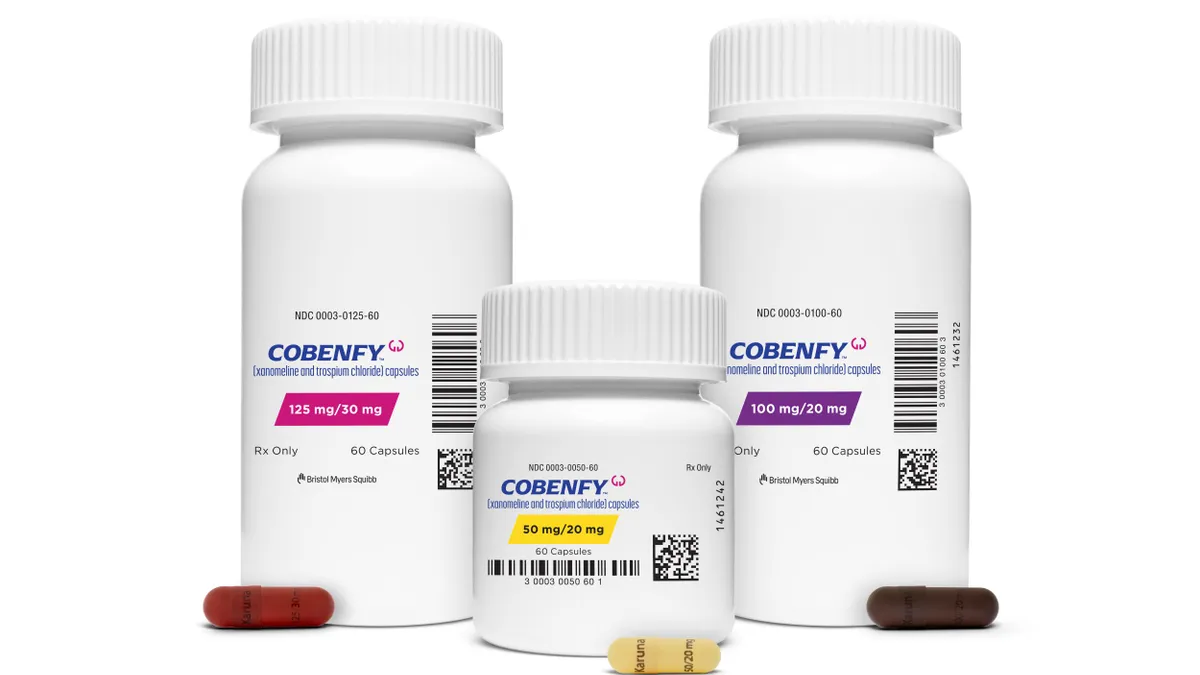
We’ve seen other novel nervous system drugs — Bristol Myers’ schizophrenia medication Cobenfy, Vertex’s non-opioid pain pill Journavx — recently come to market for enormous patient populations. Those are two large companies, and so far sales of those drugs have not impressed investors. Do those examples give you pause at all, do you see those as an apples and oranges comparison?
NATH: It's a complete apples and oranges from my perspective.
Having run Otsuka[‘s North American business] for many years, including a big schizophrenia business, the idea of a [twice-daily] drug that needs to [be taken on an empty stomach] was always going to be pretty challenging. Other than BMS, and obviously some early investors in Karuna, I don't think anyone else ever [thought] that was going to be anything other than tough.
We have the advantage that we're not BMS, so we're not expected to have the product on the shelf the next day and in every retail pharmacy the next day. We're expected to launch this like a biotech, and we're going to launch it like a biotech.
LEVINE: Although this will be a new class, in some ways, there isn't that novelty element. We've never had a problem with people having questions or concerns about these drugs working. We never get questions about whether the studies will be positive, whether these drugs actually are clinically effective.
We get lots of questions about how they'll be delivered, because a lot of people just don't understand the infrastructure and the actual commercialization. But, rightly or wrongly, from fairly early on, people have just assumed and accepted these drugs work, as opposed to an unfamiliar mechanism where there's a big educational hill to climb, along with the logistical burdens that really made the Karuna drug tough to sell.