Dive Brief:
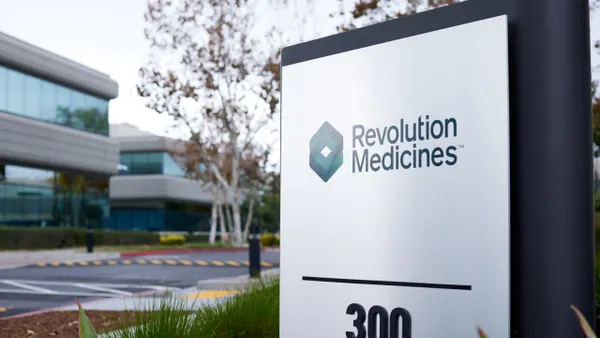
- U.S. regulators on Wednesday approved Revolution Medicines’ closely watched pancreatic cancer drug, a medication heralded by oncologists and Wall Street analysts as a game-changing therapy for a notoriously deadly tumor.
- Revolution submitted the therapy, formerly known as daraxonrasib, for review on July 22 and won a Food and Drug Administration clearance just over a month later thanks to a special kind of voucher that drastically speeds up drug evaluations. The treatment will be sold as “Rasonque” for patients who’ve already received one treatment for metastatic pancreatic adenocarcinoma and aren’t eligible for “multiagent” therapy.
- At the American Society of Clinical Oncology’s annual meeting in May, Revolution presented data showing Rasonque nearly doubled survival in the second-line setting when compared to standard chemotherapy. That benefit could prove “landscape changing,” doctors said, and might usher in a new way of treating pancreatic tumors driven by a certain type of mutation. A 30-day supply of Rasonque has a list price of $39,800, executives revealed on a conference call. Analysts at RBC Capital Markets predict about $11.5 billion in peak annual sales.
Dive Insight:
Rasonque targets mutations to “RAS,” a family of genes associated with a constellation of tumor types. Prior to its clearance, a couple other drugs targeting a specific type of “KRAS” mutation made it to market. But both haven’t become big sellers, and Rasonque works via a different “molecular glue” mechanism that’s positioned it as a major scientific advance.
The impact of that approach was on display this spring, when Revolution revealed that pancreatic cancer patients who’d received Rasonque in a Phase 3 trial lived a median of 13.2 months after treatment, compared with 6.7 months for trial participants on chemo. The results received a standing ovation at ASCO. Some experts called the findings “unprecedented.”
In a May interview, Revolution’s chief development officer Alan Sandler said the study marked the first time “any patients with pancreatic cancer” had lived a median of more than a year after receiving an experimental drug treatment in a clinical trial. Comparable benefits were observed even among those without the specific “RAS G12” mutations Revolution primarily targeted.
Among the most common side effects observed in testing were rash, diarrhea, a type of mouth inflammation, nausea and fatigue.
“This drug showed unprecedented results in an area of high unmet need,” said Angelo de Claro, director of the FDA’s Oncology Center of Excellence, in a statement.
European drug regulators are evaluating the therapy under a “phased review” that could also lead to a speedy approval.
Clearance in the U.S. starts what’s expected to be a lucrative drug launch. As of the beginning of August, more than 2,000 people had already received Rasonque under “compassionate use,” a regulatory tool that allows patients to access experimental medicines. RBC analyst Leonid Timashev predicts sales will reach $28 million in the third quarter, ramp up to $148 million between October and December and could hit $1.1 billion by the end of 2027.
“Given the impressive data and unmet need, the market could likely support premium pricing, enabling even higher peak revenue estimates as the drug ultimately moves to other indications and larger tumors,” Timashev wrote in a Wednesday client note.
Revolution is also testing the drug in the first-line and adjuvant settings in pancreatic cancer. It’s studying Rasonque in a Phase 3 trial in non-small cell lung cancer, too.
Rasonque’s success has vaulted Revolution — rumored to be a buyout target earlier this year — to the upper echelon of the biotech sector. Company shares have skyrocketed more than five-fold over the last year and, as of Wednesday morning, traded at around $213 apiece. With a market value exceeding $45 billion, Revolution is now worth more than large-cap biotechs such as Biogen and Alnylam Pharmaceuticals.
Editor’s note: This story has been updated with Rasonque’s list price.