Dive Brief:
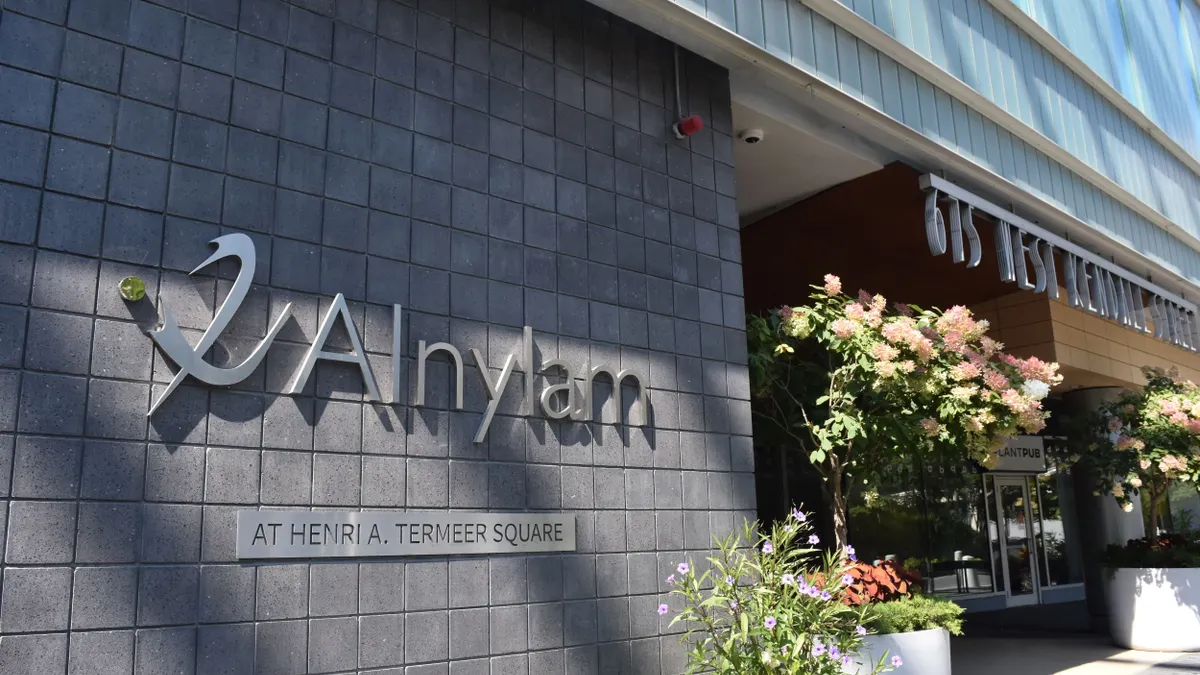
- Alnylam Pharmaceuticals is teaming up with biotechnology company Inceptive Nucleics, gaining access to artificial intelligence tools that it hopes will speed the discovery of new RNA-based therapies.
- The deal starts with $30 million up front, which includes cash and equity investments. Inceptive will also be eligible for payments based on reaching preclinical, regulatory and commercial sales milestones that could make the deal worth as much as $2 billion, the companies said Wednesday.
- Alnylam is looking for the partnership to aid the “ambitious pipeline expansion” that is part of a larger “Alnylam 2030” strategy announced earlier this year. “The goal is to help Alnylam prioritize the most promising molecules and improve experimental productivity,” the companies said.
Dive Insight:
The deal is the latest example of how AI is reshaping the pharmaceutical industry. Proponents tout that the technology will help quickly zero in on therapies with the most promise. Inceptive CEO Jakob Uszkoreit goes a step further, saying his company’s technology, in partnership with Alnylam, is “changing the way we understand and improve life.”
Alnylam takes aim at disease-causing proteins through a technique known as RNA interference. Inceptive’s AI model is designed to learn patterns of biology, in theory offering insights that can yield the best targets for Alnylam. The companies said joint exploratory work showed “exceptional performance within weeks” in characterizing so-called small interfering RNA molecules.
"Most drug design still works through a process of trial and error, testing thousands of molecules and hoping something sticks,” Uszkoreit said in a statement. “Inceptive was built on a different premise: that life follows rules of such complexity that only AI can learn them.”
There are still questions about how much AI will change drug development. Large language models learn by absorbing existing literature and data, which can be inconsistent or wrong, leading to skepticism about how well these tools will work in the long run.
Many in the pharmaceutical industry, though, are rushing to embrace the technology. Last month, Bristol Myers Squibb disclosed that it’s working with Anthropic to deploy AI throughout its operations. In April, Merck & Co. unveiled a potentially billion-dollar alliance with Google Cloud, and Novo Nordisk said it would collaborate with OpenAI on drug development.
Takeda and Eli Lilly, meanwhile, have struck deals with younger drugmakers founded on taking advantage of AI.