A surge in licensing deals involving drugs from Chinese pharmaceutical firms has triggered alarms in U.S. biotech circles, setting off arguments over what it means for national security and market competition.
Nearly 100 agreements between Chinese and U.S. biotechnology firms have been publicly announced since the start of 2025, according to BioPharma Dive data. Lawmakers on Capitol Hill have signaled intentions to try and disincentivize those investments. Among recent efforts are a push to add the biotechnology sector to the list of industries where investments in China will be scrutinized by U.S. regulators.
The issue featured prominently this week at the annual meeting of the Biotechnology Innovation Organization, the industry’s top lobbying group. Multiple panels were geared towards the way licensing deals are affecting the business development landscape and early venture investment. And during a brief meeting with reporters, BIO CEO John Crowley acknowledged the tough spot the U.S. biotech ecosystem is in as well as the pros and cons of Congressional intervention.
Protecting U.S. biotech is a “national security imperative,” and “we need to maintain our lead here,” he said.
Crowley said he hears concerns about dealmaking and investing capital, but is also thinking about how to “outcompete” Chinese biotechs. “I do worry about unintended consequences and the effectiveness of trying to put bans in place,” he said.
For many big pharmas, what began as the licensing of one or two programs from major Chinese drug developers has now expanded into massive multi-drug alliances. Two of the largest U.S. deals with Chinese pharma were announced in recent weeks: agreements between Pfizer and Innovent Biologics and Bristol Myers Squibb and Hengrui Pharmaceuticals offered hundreds of millions in upfront payments.
“China-originated assets are increasingly [seen] as core strategic pipelines rather than opportunistic bolt-ons,” Michael Yee, head of global biotech equity research at UBS, wrote in a note to clients this month.
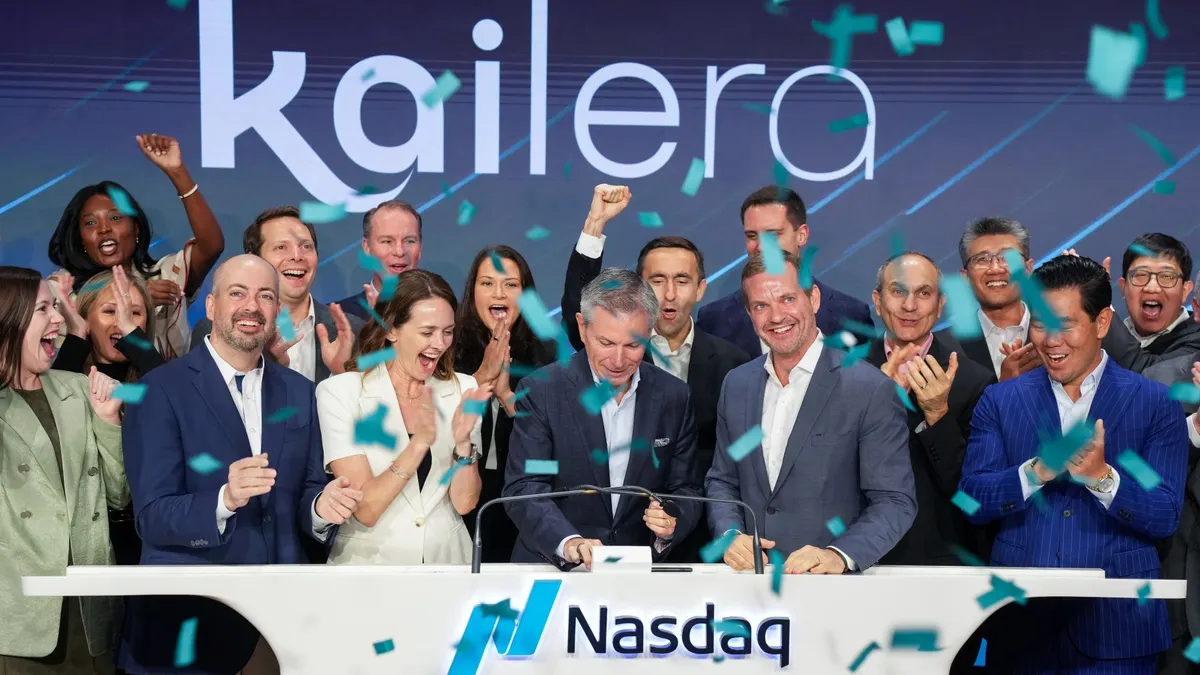
A handful of venture funds have also spun up new companies based on programs from China. Atlas Venture and Bain Capital built Aiolos Bio, which sold to GSK for $1 billion, around a biologic licensed from Hengrui Pharmaceuticals. They repeated that with a portfolio of Hengrui drugs and the buy-in of RTW Investments and Lyra Capital in what would become obesity drugmaker Kailera Therapeutics, which earlier this year landed one of the biggest initial public offerings ever for a biotech firm.
The R&D framework that enabled Chinese drugmakers to quickly discover and test new drugs has been in the works for more than a decade. What started as an effort to develop biosimilars evolved into an incubator for “me better” drugs that could outperform already approved therapies and pose a challenge to U.S. dominance in the life sciences.
In December, following years of debate, President Donald Trump signed the Biosecure Act, which saddles U.S. companies with new compliance requirements when it comes to working with some Chinese suppliers.
“There are concrete harms that will come from it,” said Peter Kolchinsky, the founder and managing partner of RA Capital Management, in an interview ahead of BIO. “If U.S. companies are the only ones that are prevented from working with China and benefiting from the efficiencies that China offers, then U.S. companies will actually become uncompetitive.”
But much of the discourse, Crowley said, could be a "distraction from the real issues, which is: how do we out-compete, and how do we reform our system to be more competitive, and the ethical concerns of trying to restrict access to what could be life-saving technology."
In hopes of clawing back that capital, the Department of Health and Human Services has introduced plans to speed up early drug research in the U.S. The proposal includes ways to clarify what data is needed before an Investigational New Drug application is filed, more flexible trial protocols, a project to allow drugmakers to consult with research institutions, and a “rolling submission” platform for the Food and Drug Administration to provide “timely guidance” to those developers.
“That's what VC is partially waiting for,” said Ashwin Singhania, a principal at consulting firm Ernst & Young. Investors are looking for an accelerated pathway so they “do not have to wait quite as long to understand what the return might be going forward.”
Kolchinsky on Wednesday described the pivot to spin up faster human testing in the U.S. as “a step in the right direction,” but said it was “still essential” that biotechs run global trials to get data as quickly as possible.
China, for its part, is introducing new initiatives that incentivize their pharmaceutical firms to prioritize drug development and patients at home. But even with federal initiatives on both sides, American companies are still seeking, and building bigger, deals with companies in Shanghai and Shenzhen in hopes it could beget approved drugs as far as a decade in the future.
The “carrot” method, as Biocom CEO Tim Scott describes it, can be part of a “balanced discussion” that also addresses concerns around intellectual property, national security and the U.S.’ competitive edge in the sector.
Scott, who oversees the trade organization that represents California biotechs, said even small developers are getting in on the game — a cohort of Californian companies took a trip to Shanghai in April for a R&D conference, blocking off time on the weekends bookending the event for partnering meetings.
“It’s important to say entrepreneurs need to build their businesses, and that we don’t close our borders,” Scott said. “We want the brightest people to solve our problems.”
Correction: A previous version of this article misstated Peter Kolchinsky’s title. He is founder and managing partner of RA Capital Management.