Dive Brief:
- The leaders of nine top European pharmaceutical boards on Tuesday pressed for government policy changes they said are necessary to prevent the decline of their industry.
- “In our boardrooms, we see Europe losing ground to global competition,” the group said in the open letter. In 1990, Europe accounted for 43% of the global pharmaceutical industry’s research and development; today “it is 31% and falling,” according to the board chairs. Europe’s share of commercial clinical studies has halved in one decade and stands at 9%, they said.
- The group blamed policies they say treat medicines “as a cost to suppress rather than one of the best investments a government can make.” They pointed to systems that hold back use of innovative medicines, “arbitrarily cap budgets” and don’t do enough to speed development. “Europe’s alarm bells are ringing,” they said.
Dive Insight:
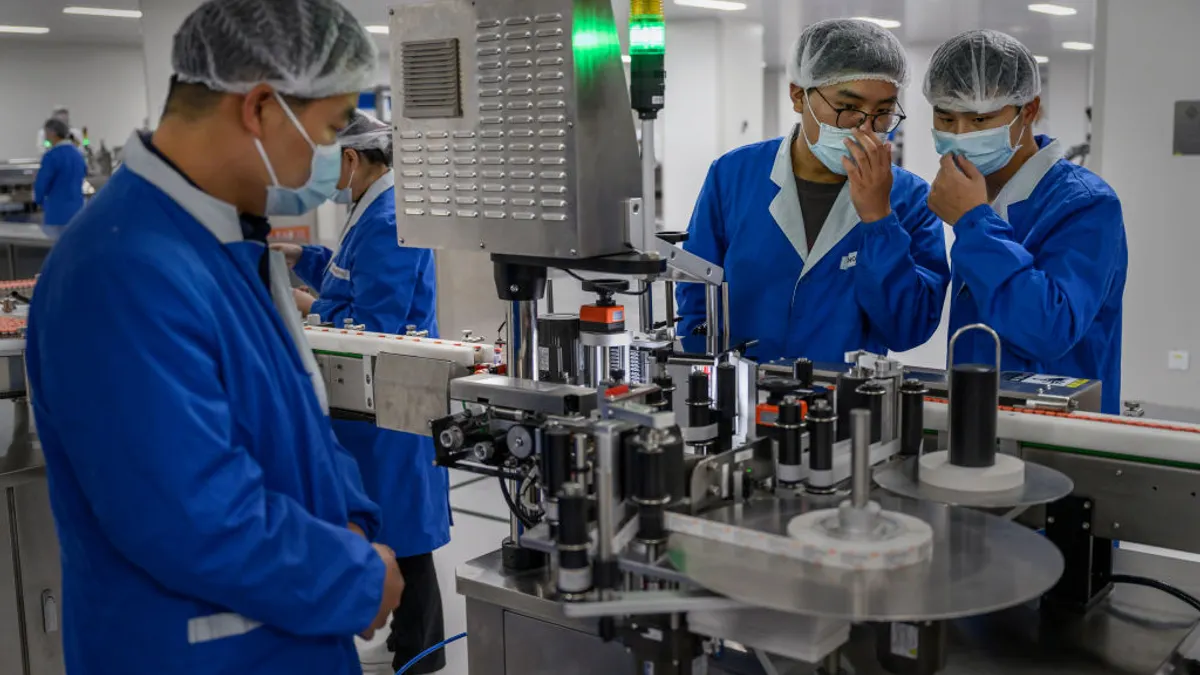
The letter comes days after China announced a new five-year plan to claim 25% of first-in-class drugs. The country’s industry has been booming in recent years, helped by lower costs and greater regulatory flexibility. U.S. leaders have responded by trying to speed up early drug research and considering ways to give drugmakers flexibility on dealmaking with China while also protecting the national industry.
The U.S. has fared better than Europe amid China’s boom, continuing to draw significant investment. And despite a series of deals touted by President Donald Trump to rein in drug costs, the U.S. gives pharmaceutical companies much more freedom in pricing compared with Europe, where companies face caps and negotiations with member states.
The board chairs drew a stark contrast between the post-World War II investments in the European pharmaceutical industry and what they said is today’s message that Europe does not value innovation. The result is an increasing gap with the U.S. and China, which together have drawn more than $600 billion in pharmaceutical investment in the last two years, they said.
They advocated for the European Union to accelerate clinical trials, protect intellectual property and adopt “sensible digital policies” while offering “fiscal flexibility” to member states. National governments need to rethink how much to invest in health budgets, how quickly they review and fund new medicines and how to modernize health care, they said.
The European Commission has proposed a European Biotech Act that addresses some of the executives’ concerns. But those leaders argued that governments also have to fundamentally rethink the value of investment in innovative medicines.
“Europe’s story does not have to be one of decline and dependency; it can be one of renewal and resilience,” said the chairs, who run the boards of AstraZeneca, Boehringer Ingelheim, Chiesi Group, Ipsen, GSK, Novo, Novartis, Roche and Sanofi.