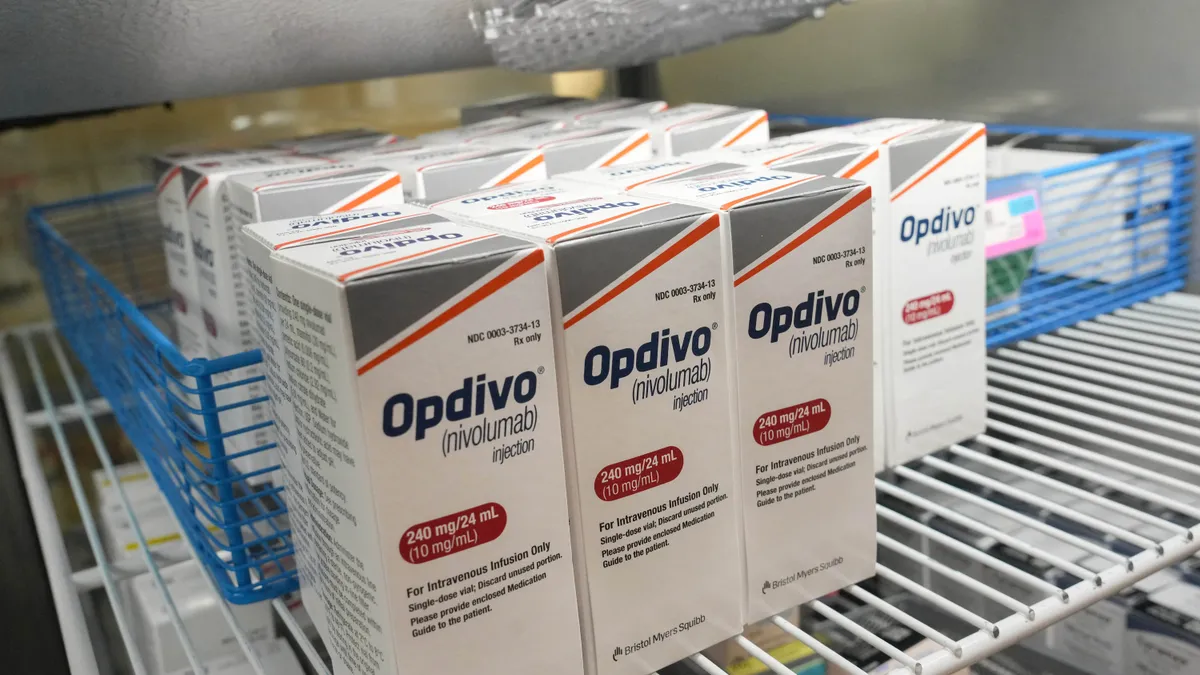
When Bristol Myers Squibb agreed to buy heart drug developer MyoKardia for $13 billion back in 2020, the deal largely revolved around one asset. Nearly six years later, that asset, sold as Camzyos, generates more than $1 billion a year as a treatment for an often genetic condition that makes heart muscle thick and rigid.
While Bristol Myers also held onto a potential successor to Camzyos, it ultimately sold the rights to another drug from the acquisition to Kardigan — a young biotechnology company created by former MyoKardia leaders. Kardigan recently ushered that drug, along with two others licensed from Sanofi and Ionis Pharmaceuticals, through mid-stage clinical trials.
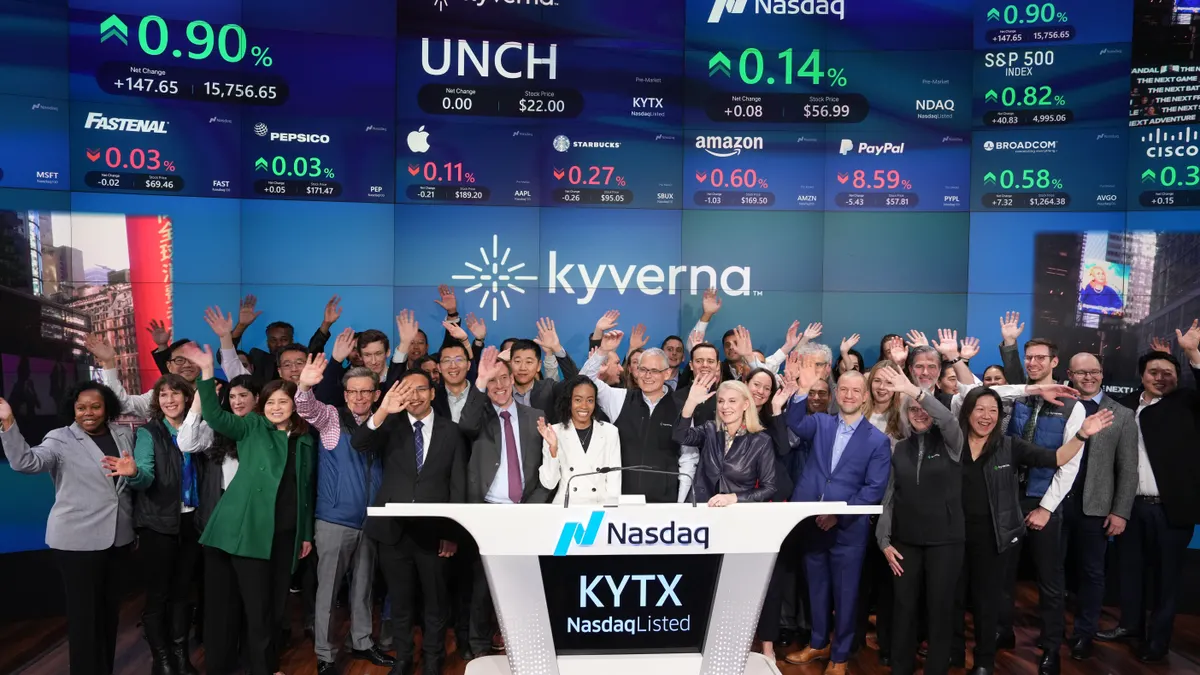
Investors appear confident that the Kardigan team can repeat what they achieved at MyoKardia. The startup had raised close to $600 million in private venture funding ahead of last week, when it brought in $400 million more through an initial public offering. The haul is the latest example of a surge in large IPOs for biotechs.
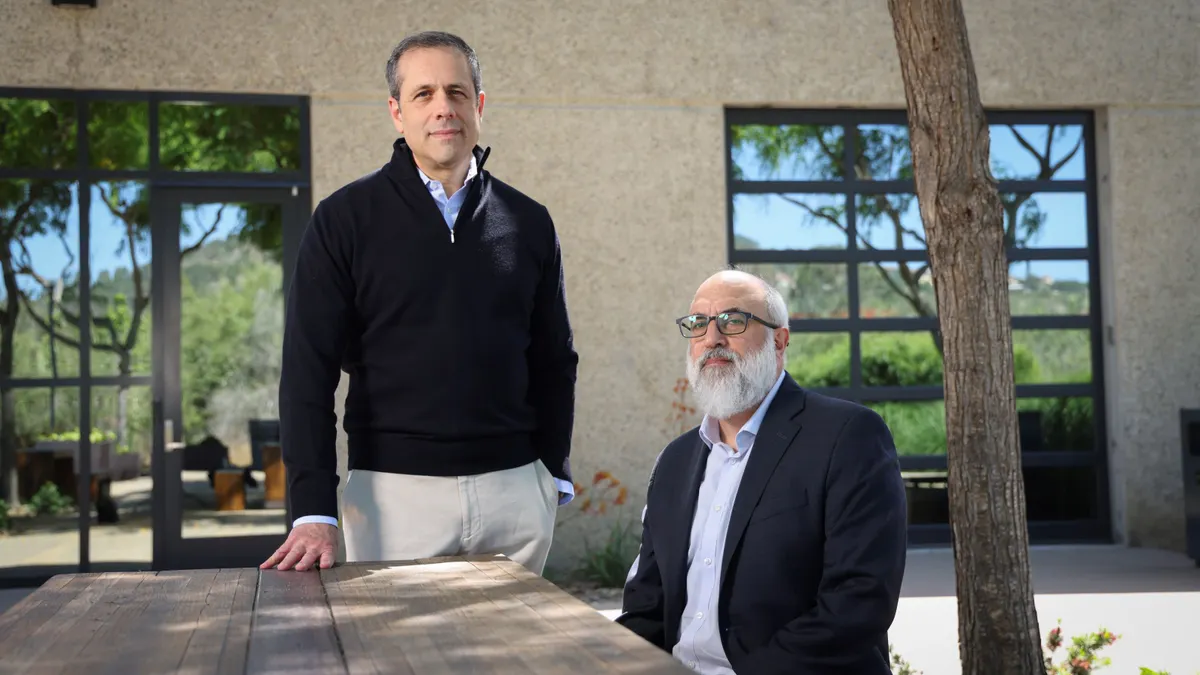
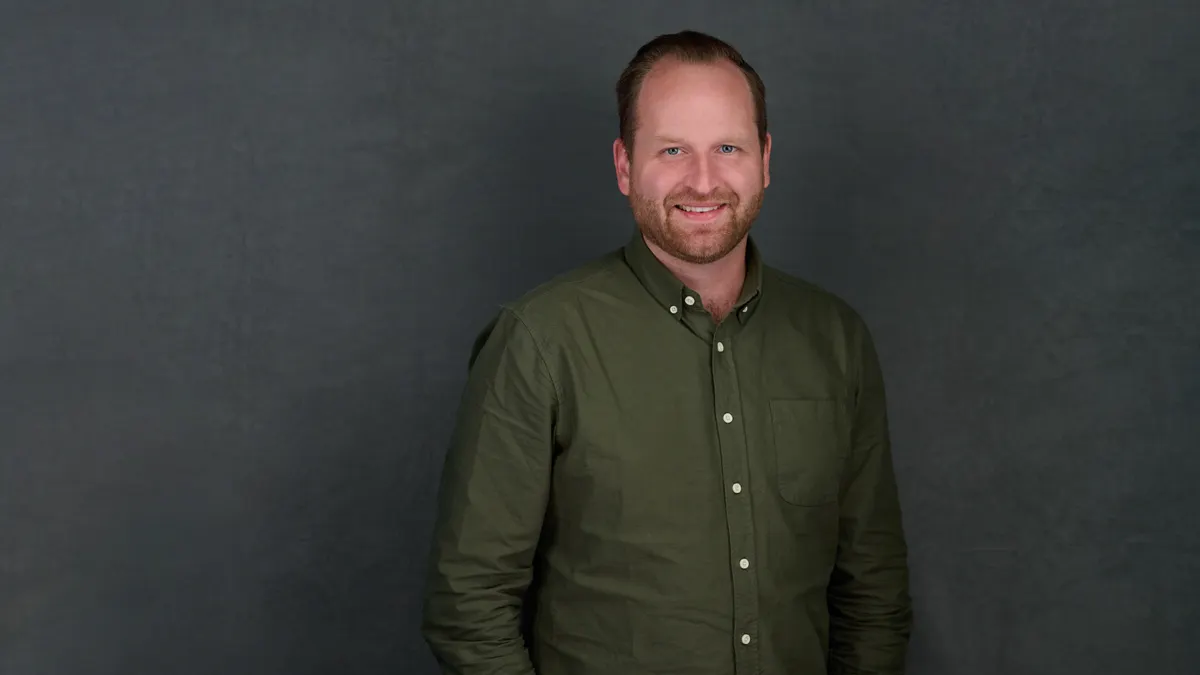
BioPharma Dive spoke with Kardigan CEO Tassos Gianakakos about his company’s IPO roadshow and what made this time around easier. Gianakakos also posited why public offerings have gotten so massive and whether these could spur some market frothiness. The following conversation has been edited and condensed for clarity.
BIOPHARMA DIVE: How is Kardigan different from being a MyoKardia 2.0?
GIANAKAKOS: There are some things that are very similar, and then some things that are absolutely different.
In cardiology, we have great imaging. We have the ability to get data from the heart from a watch, an ECG patch, medical records. So the ability to profile patients and match a targeted medicine to the right patient with that issue, that's precision medicine. Under that moniker, MyoKardia I think was one of the first to prove that the FDA’s cardio-renal division is OK with a few hundred patients in a registration program, if it is a targeted precision type of a study. Investors then started to see that we don't necessarily need to rely on 10,000-patient outcome studies, where the economics don't really work.
So the approach and discipline of cardiovascular-targeted precision medicine was inspired by MyoKardia, for sure. We saw it working. It is the way to go.
What we have today, though, are some tools and people that we didn't have available back then. We have a technology platform. We take real world data from multiple different sources — from wearable devices, from your scale at home, from electronic medical records, from your smartphone — and it gives us a continuous stream that helps us [observe] disease progression, what changes when you have an intervention.
Just think about for a minute the statistical power of a continuous variable in a study versus one snapshot at baseline, one after 26 weeks, after 52 weeks. You get tighter studies with higher powering, higher probability of success, and they're also reflective of real-world use. That platform and those tools allow us to scale. We now have three programs — at MyoKardia we had one — in a way that still allows us to be super capital efficient and very focused.
Having done it before, I think people are more comfortable coming and joining the company.
Did being a cardiovascular precision drug company resonate with investors during your IPO roadshow? Do you think operating in a disease area with more fleshed out biomarkers made drumming up excitement any easier?
GIANAKAKOS: Definitely. If you just compare this IPO to MyoKardia’s, all of that 10 years ago was not established. What was established — and sadly remains the same — is the massive burden of cardiovascular disease. It’s by far the biggest therapeutic segment, and massively underinvested in.

Ten years ago, people appreciated that. There was still skepticism around: is the FDA really going to not require large outcome studies? Flash forward to today, the medicine that BMS is now commercializing, Camzyos, it's doing like a billion and a half dollars in sales a year. There are more companies now in the category. There's another approved drug for HCM and a few others in development. And then you look at the amyloid cardiomyopathy space, and there are multiple approved products.
These categories are now big, and investors are saying, “OK. The medical need is there and it's continuing to get worse. Now I feel more comfortable because I've seen value creation, I have a pattern that I can kind of affix to, and they’ve got a team that's done it before.” That was fantastic to see, and we felt it all during the whole IPO process. It was pretty front and center.
I remember analysts discussing the dearth of cardiovascular assets to buy after MyoKardia got acquired. Does it surprise you that, at least in recent years, this segment hasn’t seen more deals or investment dollars?
GIANAKAKOS: Pharmas need products that are going to help them generate revenue in the near term. So, the later the stage, the more interesting it is for them. And when you look at the amount of drugs in development, there are 10 times more drugs in oncology than in cardiology. Only something like 8% to 10% of all drugs in development, maybe even less, are focused on cardiovascular disease today.
[Some choose not to fund cardio companies] because the model for investment is super expensive. J&J and BMS are doing a 50,000-person study. That’s got to cost like $2 billion to $3 billion. That is not necessarily going to encourage the needle to move, in terms of the numbers of drugs [getting developed].
Even sitting here today, there are not that many companies out there with full-stop cardiovascular clinical assets, let alone late-stage assets that could help top lines in the next two to three years. There are really just a handful. Investors are more receptive than they were 10 years ago, but the need is still there more than ever.
Why did you feel the need to essentially do this all over again? Was it too hard to watch the asset BMS didn’t want die on the vine? What spurred the idea to build another company in this vein?
GIANAKAKOS: There's unfinished business.
It was so clear to us within MyoKardia that this approach works. When you're doing precision medicine, you are as interested in understanding patients who don't respond as those that do. Those not responding don't make it in the label. When you're looking for what's different, it starts to unearth the underlying disease biology and spur ideas around new pathways and new drug discovery programs. That kind of information is gold. And it's very rare.
We didn't get a chance to follow through on all of it. We have new tools, and hopefully this second time around, I've learned a couple things. Hopefully investors see us as the platform cardiovascular medicines company that they can lean in on. We have a portfolio, we can make it easy for them.
We've got an opportunity, a proven leadership team, a pipeline so there’s no binary risk. We’re not early-stage, so we don't have to translate mouse data into humans. And, with all three disease areas we're in, these are big, with no approved drugs, so no competition on the horizon.
What do you make of these larger public debuts, especially after a period where it was hard to get an IPO done for really any biotech. Now, this $400 million haul isn't exactly the craziest thing.
GIANAKAKOS: I think you're seeing companies that are solving real problems with compelling clinical data, and management teams that [investors] have seen deliver value and trust. I don't know if it's every IPO over the last six months, but certainly some of the more recent notable ones I think fall in that category.
There's always capital available. Ultimately, good management teams, good products that the world actually needs, clinical data you can look at and say, “This thing is doing something that is going to make a difference,” I think that's what we're seeing here.
I don't want to speak for other companies, but that's a lot of the engagement and interest we've had. We're at a point in time now where investors have capital, they've held off from deploying it for a while, and now they're seeing opportunities where they're ready to go.
In good part because of the tech industry, IPOs seem to be on everyone’s mind right now. Do you think that played any role at all in your experience going public?
GIANAKAKOS: The pools of capital are distinct. But I do think that there is something to be said for “IPO” as a category, where it's helpful on the margin. I would say it's helpful to see a successful SpaceX IPO, etcetera. It's always good.
When people are making money, they are “recycling the capital.” You've all of a sudden made, like in the case of SpaceX, billions of dollars that people now have to redeploy. So it now becomes available to other companies in the sector, or other companies investors are interested in.
There is a healthy synergy. There's a balance between having capital available to IPOs and, let's say, crowding out each other. But in a good market like this, I think, on the margin, having AI companies doing well, it's making people money. That money tends to find its way back into the markets.
Once upon a time, we thought about biopharma as almost counter cyclical. It doesn't matter what rates are: people are sick, and these medicines will still get reimbursed and approved. So I think sometimes we remind investors this is a segment that can be pretty steady, even when other areas might be a little more volatile.
I'm not an expert in AI, but there's a lot of conversation around: are these companies worth what they are? We're developing medicines for diseases that aren't going away. So we don't have that kind of concern on our end.
How impactful is having late-stage assets? Do you think that’s something that de-risked the company to many investors as Kardigan conducted its IPO process?
GIANAKAKOS: It’s really important, actually.
In almost any market, if you have late-stage data that people can understand, in an area that needs a new medicine, and ideally with a team that you know and you trust that has credibility, I think those companies tend to always be financeable. In a good market, maybe they raise a little more at a better price. But they're always going to be able to capitalize that work and continue it.
Sometimes, in really hot markets, we get companies that aren't quite as mature and developed. If they’re public before a clinical proof-of-concept [study], it's a tricky bet to make right. You're really relying on animal data or cell-based data.
We timed the IPO in our process to be not too early, not too late. Too early for us would have been before we had clinical proof of concept data. All of these programs have more data than MyoKardia had at the time it went public, and that was very deliberate. We wanted to make it easy for investors, but we also wanted to go public before the next batch of data.
Is there any concern the large valuations we’ve seen in recent biotech IPOs could either lead to market frothiness or set really high expectations for companies that are now public?
GIANAKAKOS: If we had a time machine, went forward a few years and saw ourselves in one of these frothy markets, I think it would be reasonable to point to moments like this to say this is when it started. But that doesn't mean we’re going to get there.
As far as I can see, I don’t think it’s frothy. The companies going public now have quality management teams and important products that have late-stage data. Where flags might start coming up is if we start to see companies going public earlier and earlier. If you start to see that there's creep in the IPO markets, to companies going with just Phase 1 data, maybe Phase 2, that's when we want to be careful. That might start signaling a little bit the beginning of the end.
It’s not a judgment on management teams, by the way. They have a choice: they could raise money privately or they could go public, and usually the public option in that market is cheaper. So it’s tricky.
Early this year, investors were swearing how they learned their lessons from the last biotech boom and bust cycle.
GIANAKAKOS: I'm sure every industry is littered with this, but if you're just a student of history, it's clear we don't learn our lessons. Stuff just happens, and there are reasons for it. There are different economic cycles; other industries are cooling off and people need a place to put their money.
I have a lot of respect for investors. To me, I keep it kind of simple: if this company wins, is anyone going to care? Are you doing something important? Because to get to “the win” requires a lot of great science, a lot of great people. And if things wobble, do I trust these people to be able to course correct?
If you're playing catalysts — like data or a big pharma buy — you have counterparty risk, you have market risk. You're looking at the crystal ball. It's almost like timing the market, and that seems hard to do. I think it's just a whole lot easier for an investor to say, “Do we think these guys can do it or not?”