Dive Brief:
- Merck & Co. and partner Gilead Sciences on Monday reported a setback in one late-stage study in lung cancer, but success in two other Phase 3 trials testing an HIV treatment they’re working on.
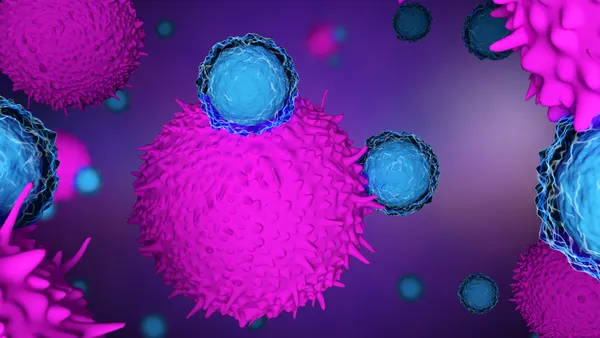
- In one announcement, the companies said they’re halting a trial testing Gilead’s Trodelvy with Merck’s Keytruda in frontline, non-small cell lung cancer. Study monitors found a “numerical improvement” in tumor progression that didn’t reach significance, and determined a survival benefit was unlikely.
- In the other release, the partners revealed an HIV tablet combining Merck’s islatravir and Gilead’s lenacapavir benefited people who “switched” off of other treatments in two Phase 3 studies. They intend to seek approval of the combination, which could be the first oral, once-weekly treatment for HIV. They didn’t specify when an application might be completed, however.
Dive Insight:
The trio of study results appeared to impact both companies more negatively, given the high-profile nature of the setback in lung cancer.
The “EVOKE-03” study was another chance for Gilead to validate the hefty $21 billion purchase price it paid for Trodelvy’s developer Immunomedics. That treatment hasn’t been as big a seller as Gilead once envisioned, and has stumbled in multiple other studies. But success in a study in frontline lung cancer, one of the most common tumor types, would’ve helped.
The study was also a chance for Merck to extend its dominance in lung cancer, for which Keytruda is a pillar of care. The trial tested Trodelvy, an antibody-drug conjugate aimed at the protein TROP2, alongside Keytruda in the first-line setting. But some analysts were skeptical of the study’s chances, given the way it was designed — the companies didn’t only focus on TROP2-expressing tumors — and Trodelvy’s other struggles.
The readout additionally carries implications for another ADC Merck is investing heavily in. Called sacituzumab tirumotecan, or sac-TMT, Merck licensed it from Kelun Biotech and has place it in a sprawling Phase 3 program that includes 17 studies targeting a range of tumor types. Merck believes the ADC could become a “cornerstone” drug, and recently spotlighted results from a Phase 3 study in China at the American Society of Clinical Oncology conference.
Analysts and investors have been debating whether those findings might carry over to a global study in first-line lung cancer that’s now underway. Merck has expressed optimism, citing certain technical differences with sac-TMT. But the EVOKE-03 results could put “greater investor scrutiny” on sac-TMT data coming from China “until the global translation is proven,” wrote Leerink Partners’ Daina Graybosch.
Graybosch expected the stocks for both companies to trade lower given “outsized investor attention on the more negative of the two announcements.” Shares of Gilead dipped 3%, while Merck’s stock was only slightly down.
Yet the HIV findings could ultimately offset those negatives. Despite a concerted push into oncology, Gilead’s core business remains its HIV drugs. It’s already added to that portfolio with last year’s approval of a preventive shot called Yeztugo. Another drug for the “switch” market could boost that business, as some 20% of patients change treatment regimens each year, Graybosch wrote.
The positive results also amount to another “win for Merck’s HIV franchise this year,” following the April approval of Idvynso, RBC Capital Markets analyst Trung Huynh wrote in a separate note.