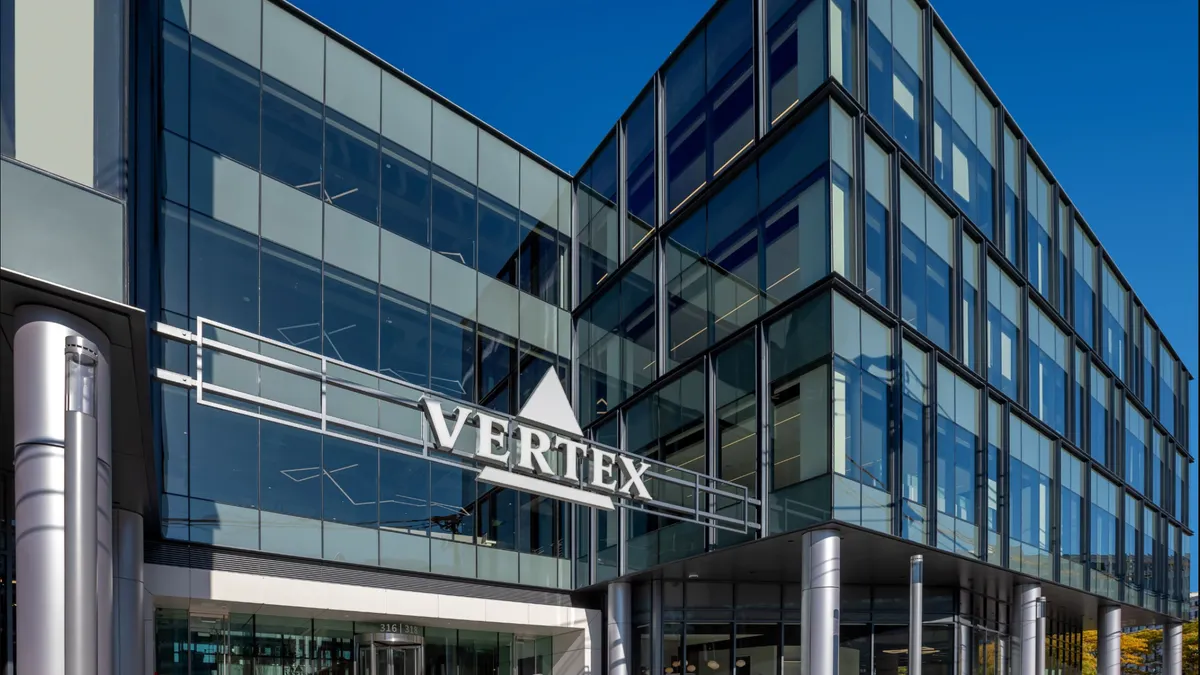
Vertex Pharmaceuticals was the lone bidder in a planned, $10 billion acquisition that has some investors questioning whether the biotechnology giant overpaid on its largest-ever deal.
Financial documents filed Tuesday provide an inside look at the tie-up between Vertex and Crinetics Pharmaceuticals, a California-based company specializing in endocrine drugs. Crinetics has one marketed therapy for an uncommon hormonal condition, as well as an experimental medicine in late-stage testing for a rare genetic disease called congenital adrenal hyperplasia. Vertex estimates that, together, the two drugs could generate north of $5 billion a year at their peak.
Yet, at a 102% premium, the $85-per-share offer is one of the biggest markups this year for a biotech buyout, according to BioPharma Dive data. When Vertex shares dipped after the deal’s announcement, analysts suspected that investors weren’t happy with the price tag. The deal value “assumes a bullish case outcome” for Crinetics’ drugs, and will likely stir debates about whether Vertex “paid full price or even a rich price,” Stifel analyst Paul Matteis wrote in a July 6 note to clients.
The newly released documents “are likely to reignite” that investor scrutiny, according to RBC Capital Markets analyst Brian Abrahams.
The seeds for the acquisition, like many biopharma deals, were planted at the industry’s annual bellwether event: the J.P. Morgan Healthcare Conference. Crinetics’ filings describe how, during that mid-January conference, its own representatives met with Vertex’s external innovation team “as part of ordinary course business development activity.”
A couple months passed before Vertex, on March 14, reached out to Crinetics’ CEO R. Scott Struthers about a potential transaction. By March 24, Vertex submitted a proposal to buy all of the biotech’s outstanding shares for $78 apiece, reflecting a 125% premium to the stock’s most recent closing price.
Crinetics quickly tapped Leerink Partners and J.P. Morgan to serve as financial advisors, and, together, this team spent the next 10 days evaluating the proposal. Crinetics’ board of directors acknowledged the sizable premium, but believed that, since this was an initial offer, Vertex would be willing to go higher. On April 5, the board rejected the bid but cleared Struthers to tell Vertex they may reconsider if terms were “significantly improved.”
On April 19, Vertex revised its offer to $83 per share, which, by that time, represented a 102% premium. But it still didn’t pass muster. Crinetics’ board members knocked down the new proposal three days later. And, with adviser help, they came up with a list of six other companies that might be interested in — and have the resources to finance — a substantial transaction.
In the final week of April, three of those six counterparties conveyed they didn’t want to make a deal. Another, “Party A,” did express interest. By May 1, however, it determined it couldn’t propose a transaction worth north of $6 billion. After some back and forth, “Party A” dropped out of the deal process. The final two contenders followed suit the next week.
From May 8-28, Crinetics and Vertex continued to exchange due diligence information. On that latter date, Vertex upped its offer to $84.50 per share, or a 130% premium. The Crinetics board concluded that, because this new offer would be dilutive to Vertex’s earnings per share in the near term, it was likely at or close to the maximum Vertex would be willing to pay.
Still, the board wanted to see if it could squeeze out a little more, so they relayed a counterproposal of $87 per share.
Vertex representatives said further due diligence was required before they could put forward a final offer. On June 19, a senior representative contacted Struthers and said Vertex was prepared to buy Crinetics for $85 per share. Crinetics tried to eke out one more dollar per share, but Vertex responded that the $85 price point was its best and final offer.
Crinetics’ board found this acceptable, and after squaring away other final concerns, the companies reached an agreement on July 6.
In his note, Abrahams admitted that Vertex appearing to be the only party “seriously engaged” in this deal process “may reinforce the notion for some investors” that the company overpaid. Even so, the RBC team thinks the deal size “can be justified” and that Vertex is “well-equipped to unlock additional value” from Crinetics’ drugs.
The “long lead-up” to the companies reaching an agreement should reassure investors that the deal timing “does not reflect any acute reduction” in the confidence Vertex has in its base business, Abrahams added.