Dive Brief:
- Merck & Co. on Thursday said a drug it’s developing to treat diabetic macular edema succeeded in a late-stage trial, while also noting some potential safety concerns.
- In the late-stage “Brunello” trial, the drug, called remigromig, reached the mark of “non-inferiority” when measuring patients’ visual acuity compared with those given Roche’s Lucentis, Merck said. But the company also said it’s conducting further analyses to understand higher rates of proliferative diabetic retinopathy, bleeding inside the eye and treatment discontinuations among those given remigromig.
- The New Jersey-based drugmaker acquired remigromig in a $1.3 billion takeover of privately held EyeBio two years ago. The medicine, then known as Restoret, had already delivered positive results in a Phase 1b/2a study in patients with diabetic macular edema as well as those with the “wet” form of age-related macular degeneration.
Dive Insight:
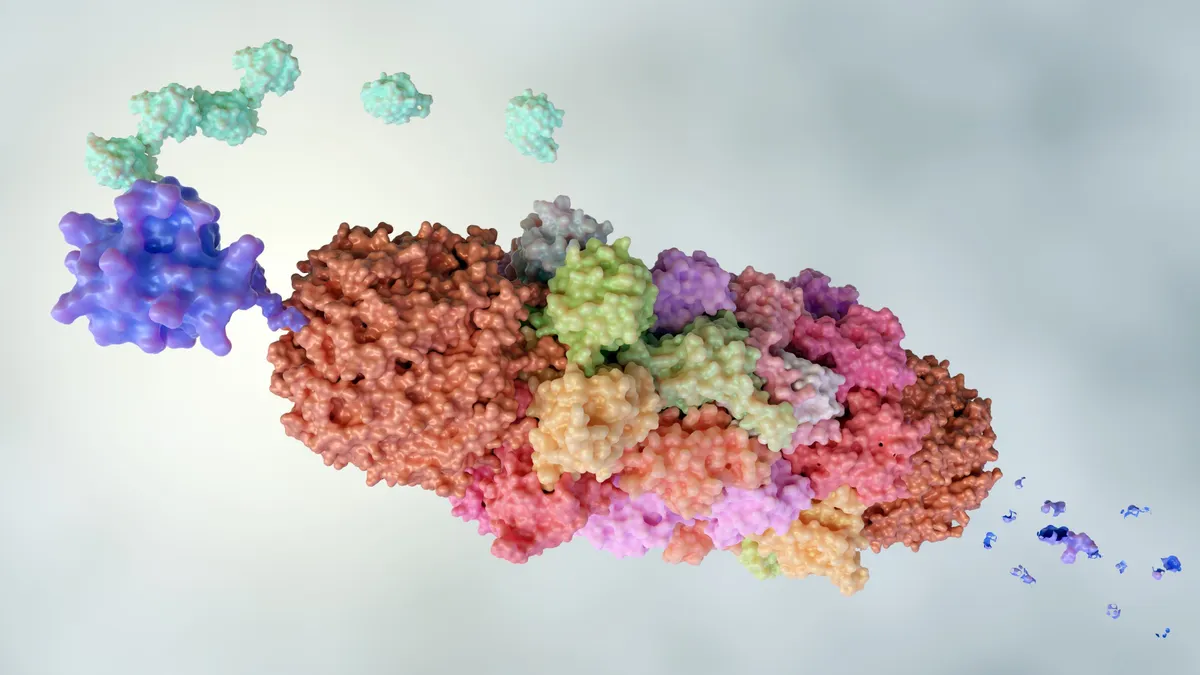
Remigromig is one of many moving pieces in Merck’s plan to reach $70 billion in annual sales next decade even as it weathers the loss of market exclusivity for the top-selling cancer medicine Keytruda. The injection is part of a new class of medicines designed to restore the blood-retinal barrier by targeting a signaling pathway known as Wnt.
While Merck got a modest 1% bump in its stock price on the results in early trading Thursday, shares of eye drug specialist Surrozen doubled after the announcement. The company is developing a similar treatment that analysts say has blockbuster potential.
For Merck, the results were “mixed,” RBC Capital Markets analyst Trung Huynh wrote in a note to clients. The efficacy results were encouraging and offer validation for targeting Wnt with a drug, he wrote. “However, the new safety disclosures give us some concern,” he added.
Another analyst, Evercore ISI’s Umer Raffat, was less worried. He noted that one-off vitreous hemorrhages have been seen in other eye drug trials. “This disclosure is made in classic Merck conservative fashion,” Raffat wrote to clients. In his opinion, “this is not a reflection of something bad that has happened.”
Merck didn’t release details in its announcement on Thursday, saying full results from the first year of the trial would be presented at a medical meeting on Oct. 10. Researchers are continuing to follow patients who in their second year will have more individualized treatments, potentially reducing the frequency of the eye injections administered every four weeks in the first year.
The drugmaker is also evaluating remigromig in a second pivotal trial focused on diabetic macular edema, as well as a Phase 2 proof-of-concept study in two other eye conditions. And Merck has also moved a different ophthalmic medicine acquired from EyeBio, MK-8748, into late-stage testing as well.
Traditionally known as a powerhouse in cancer, heart disease and vaccines, Merck has made several forays into the world of ophthalmology to expand its pipeline. A partnership with NGM Biopharmaceuticals on a geographic atrophy drug fizzled out after disappointing study results in 2022. In 2024, the company moved onto the EyeBio acquisition, which came with the potential for an additional $1.7 billion in milestone payments on top of the initial $1.3 billion in cash.