Dive Brief:
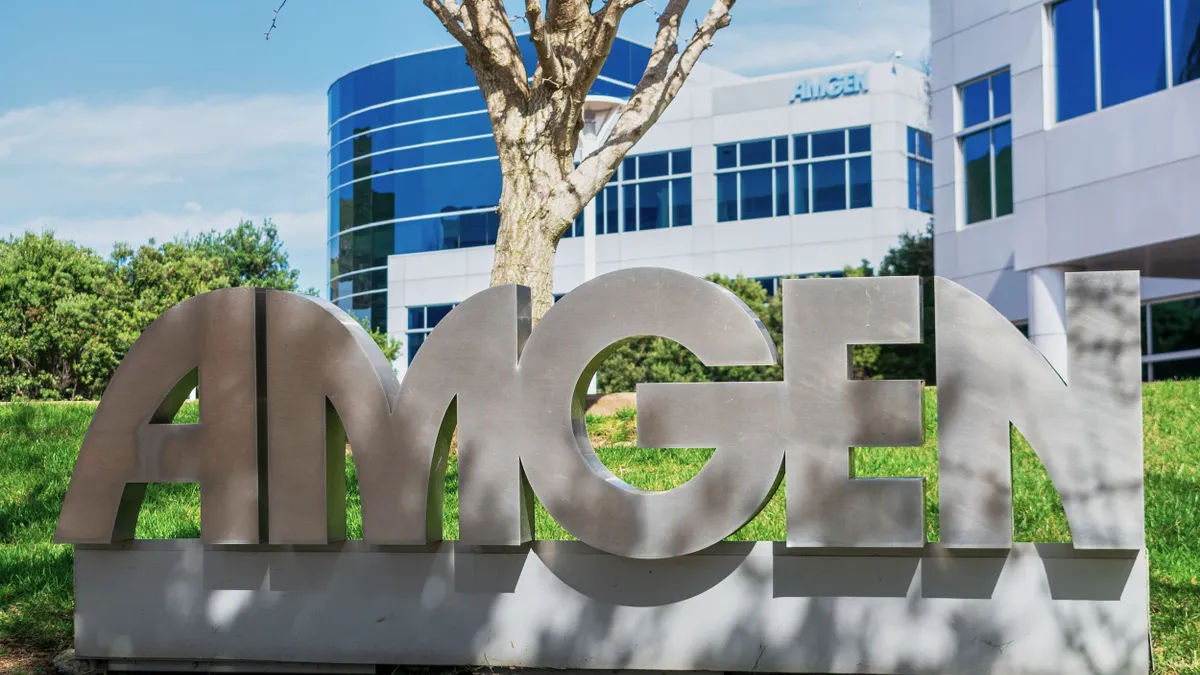
- An experimental Amgen drug has succeeded in the first of two Phase 3 trials in Sjögren's syndrome, driving the California biotechnology giant’s stock price up as much as 5% on Tuesday.
- Amgen didn’t provide specific details about the performance of its drug dazodalibep. But it said in a Tuesday statement that treatment led to a “statistically significant and clinically meaningful improvement” on a widely used measure of disease activity after 48 weeks, meeting the trial’s primary objective. Positive effects were observed as early as four weeks after treatment and persisted through the evaluation period, Amgen said.
- Investigators didn’t spot an “imbalance” in the rate of blood clots or opportunistic infections in the Phase 3 study, a potential concern of drugs with dazodalibep’s mechanism. Side effects were generally mild to moderate, and study discontinuations were infrequent and balanced across study arms, the company said.
Dive Insight:
Sjögren’s has been a tricky target for drugmakers. There are no approved treatments that can alter the course of the condition, in which the immune system errantly attacks moisture-producing glands and causes chronic dry eyes and mouth, pain, inflammation and other health problems. Patients have a higher risk of lymphoma as well.
Dazodalibep interferes with a key communication channel between immune cells. Blocking this CD40-CD40L pathway is meant to blunt the hyperactive immune response and formation of tissue-damaging autoantibodies in Sjögren’s. The approach showed promise in earlier testing, with participants in a Phase 2 trial experiencing a reduction in symptoms and disease activity.
The drug came to Amgen after changing hands multiple times. It was originally discovered by AstraZeneca, which spun it into a startup, Viela Bio, that Horizon Therapeutics acquired in 2021. Amgen then bought Horizon two years later, inheriting dazodalibep along with multiple other prospects.
Dazodalibep is now among the more closely watched prospects in Amgen’s pipeline. The results announced Tuesday come from the first of two pivotal studies in Sjögren’s. The second, in patients who have a “high symptom burden,” is expected to produce data in the fourth quarter.
"These topline results provide further support for dazodalibep as an emerging treatment for improving systemic disease activity and represent an important advance for the field,” Ghaith Noaiseh, the study’s lead investigator and an immunology professor at the University of Kansas Medical Center, said in a statement provided by Amgen.
Without detailed findings — they’ll be disclosed at a future medical meeting — it’s not yet clear how Amgen’s drug stacks up against other emerging competitors. Novartis has an experimental therapy called ianalumab that could be cleared by regulators this quarter. Bristol Myers Squibb is also due to report Phase 3 data testing its drug Sotyktu, a marketed treatment for psoriasis, in Sjögren’s.
The study specifics Amgen eventually presents will “help inform positioning” against ianalumab, wrote David Risinger, an analyst at Leerink Partners, in a note to clients. Risinger added that his team and other analysts have “very low expectations” for Bristol Myers’ study.
In a separate note, William Blair analyst Matt Phipps wrote that he was “encouraged” by the announcement given his team has viewed the dazodalibep program as “relatively high risk.” He cautioned, though, that Amgen’s two Phase 3 trials involve “distinct” patient populations and the company will need victories in both studies to win regulatory approval.