Today, BioPharma Dive is highlighting some notable clinical trial updates presented at the annual World Conference on Lung Cancer. Over the last few days, several large pharmaceutical and biotechnology companies released detailed study data on new and emerging medicines for lung tumors.
Below are three notable storylines and a look at how they’re being interpreted by investors and analysts.
The ‘ADC era’ for small cell lung cancer
Of the two major forms of lung cancer, the “small cell” variety is widely known as the more difficult kind to treat. Accounting for anywhere from 10% to 15% of lung cancer cases, these tumors grow and spread more quickly than their “non-small cell” counterparts. People are often diagnosed with “extensive stage” disease, too, meaning their tumors have already gotten into both lungs or other parts of the body. Typical treatments, which involve chemotherapy, immunotherapy and radiation, can extend survival for about a year afterward.
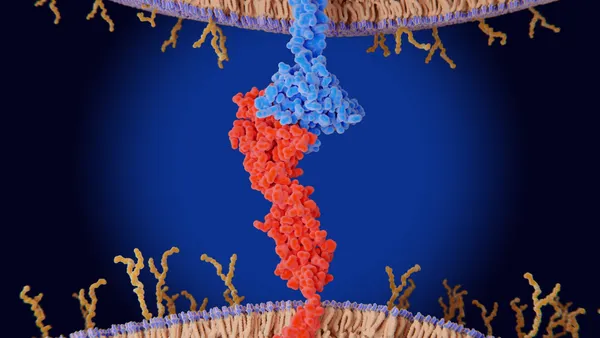
An emerging group of antibody-drug conjugates could soon upend care for these tumors. Aimed at a protein called B7-H3 that’s overexpressed in SCLC, these treatments have shown the ability in clinical testing to outperform standard chemotherapy. Two, discovered by China-based biotechs and licensed in recent deals to Roche and GSK, were showcased at WCLC this past weekend.
In a Phase 3 study conducted in China, Roche’s drug, known for short as “tam-peli,” was tested against the chemotherapy topotecan in people whose disease had progressed after chemo and potentially a kind of cancer immunotherapy. On Sunday, Roche presented data showing the drug reduced the risk of death compared to the chemotherapy topotecan by 54% and disease progression by 71%. Patients on tam-peli lived a median of 13.3 months, about four months longer than those on chemotherapy. Treatment was also associated with a more than four-month benefit on tumor progression and a roughly 59% response rate, versus about 10% for chemo recipients.
GSK’s “riz-rez,” meanwhile, also cut the risk of death by 54% when compared to topotecan in a different China-only study. According to GSK, patients on riz-rez lived a median of 18.5 months, versus 10.3 months for topotecan recipients. Tumor progression was slowed by a median of 7.2 months, compared to 3 months for people receiving chemo.
Roche and GSK currently have global studies underway that’ll test whether the results achieved in China can be replicated in more diverse populations. Analysts and physicians expressed optimism that they might. In a research note, Jefferies analyst Michael Leuchten referred to riz-rez as an “underappreciated, potentially major oncology asset” that could become a “core second-line option” if the global studies are positive. And Stephen Liu, the director of thoracic oncology at Georgetown University’s Lombardi Comprehensive Cancer Center, proclaimed in a post on X that Roche and GSK’s trials “reinforce each other.”
“The ADC era [is] soundly here for SCLC and these will replace chemotherapy across lines, in my opinion,” he wrote. — Ben Fidler
China questions
While some are hopeful that GSK and Roche’s findings will be reproduced in international trials, one presentation offered a cautionary tale.
In June, Gilead Sciences and Merck & Co. said they were halting a multicountry study testing their respective drugs Keytruda and Trodelvy in frontline, non-small cell lung cancer after researchers determined a survival benefit was unlikely. That result erased a lucrative opportunity for both companies. It also added to an ongoing debate about whether drugs showing promise in China-only studies are more likely to succeed in broader trials, too.
Detailed findings from Gilead and Merck’s trial were presented at WCLC over the weekend and, importantly, revealed significant differences in treatment benefits depending on patient demographics. In the overall study population, the Trodelvy/Keytruda combination was associated with a slightly greater risk of death — a so-called hazard ratio of 1.07 — when compared to Keytruda alone. However, an exploratory post-study analysis found there to be a 45% reduction in death risk when only looking at enrollees in China. Among those in East Asia, that figure was 37%.
“You can see why [the] Street has so much emphasis on U.S. trials,” wrote Evercore ISI analyst Umer Raffat.
Whether such discrepancies will materialize in other studies carries important implications for several drugmakers. One is Merck, which reported earlier this year that a drug called sac TMT posted a 65% reduction in the risk of disease progression or death in a China-run study in a similar setting. Another is Summit Therapeutics, whose Akeso-licensed drug ivonescimab was touted at WCLC for extending survival in a China-only trial, but still faces skepticism about its prospects in an ongoing international study.
“Though it is certainly not a truism that China studies will produce better survival outcomes than global counterparts, the preponderance of evidence indicates this may be the case,” wrote Leerink Partners analyst Daina Graybosch. — Ben Fidler
AstraZeneca’s spotlight
Few companies have as much staked on their cancer pipeline as AstraZeneca. The British drugmaker’s oncology business is a cornerstone of its bid to achieve $80 billion in revenue by 2030. Lung cancer is a critical part of those plans, as AstraZeneca wants to have medicines available by then for more than half of all people with the disease. But recent trial setbacks, including the failure of a lung cancer drug, have raised questions about AstraZeneca’s growth prospects.
A handful of WCLC presentations provided a look at what’s ahead. One study, “DESTINY-Lung04,” pit the company’s popular ADC Enhertu against Keytruda and chemotherapy in frontline, HER2-positive non-small cell lung cancer. Researchers found that Enhertu cut the risk of tumor progression or death by 37% compared to the Keytruda-chemo combo, suggesting that the ADC could erode Merck’s dominant position in lung cancer.
Still, AstraZeneca has other competitors to deal with. Oral drugs from Boehringer Ingelheim and Bayer are also available for HER2-positive lung tumors. Those drugs have “the upper hand here with a more manageable [side effect] profile with similar efficacy,” wrote RBC Capital Markets analyst Trung Huynh.
AstraZeneca also featured multiple studies of its top-selling cancer drug, Tagrisso, in the hopes of further widening use in EGFR-mutated disease. One presentation included an analysis of the ADAURA trial showing that, when tested against a placebo in the “adjuvant” setting after surgery, Tagrisso lowered the relative risk of death by 47%. Around three-quarters of the enrollees who got Tagrisso were alive after eight years.
A second study pairing Tagrisso with Hutchmed’s savolitinib showed the combination doubled progression-free survival in people with so-called MET mutations compared with Tagrisso alone.
AstraZeneca is also one of the few companies still working on a medicine that targets the protein “TIGIT,” once the focus of a far-reaching push in immunotherapy research. The company’s drug rilvegostomig, aims at TIGIT as well as the checkpoint protein PD-1. According to AstraZeneca, enrollees who had high levels of a protein linked to immunotherapy responses had a 62% response rate and went a median of 17 months before disease progression or death.
However, ahead of the conference, Leerink analyst Andrew Berens wrote that he was “cautious” about the coming results. The findings depend on “incremental efficacy” from the drug’s TIGIT-targeting component and should be viewed “skeptically given the high volume of negative TIGIT data,” Berens added. — Jonathan Gardner