With quarterly earnings underway, BioPharma Dive is providing a snapshot of some companies’ results and how they’re being received by investors. Today, we’re offering insight into the latest numbers from Eli Lilly, Novartis and GSK.
Lilly’s unwavering momentum
Eli Lilly blew past Wall Street analysts’ forecasts on Thursday, posting third-quarter revenue that topped consensus projections by 8% as its widely popular diabetes and obesity drugs Mounjaro and Zepbound once again beat expectations.
Lilly hiked its full-year guidance by $5 billion, too, producing a beat-and-raise quarter that sent shares of the Indiana-based drugmaker surging as much as 9% Thursday.
For Lilly, the report appeared to put to rest investor concerns that Medicare’s “Bridge” program, which was implemented on July 1, might impact its obesity drug revenue. Investors were also anxious about the fast-changing pricing dynamics in the market for weight-loss medicines.
The "strong execution across the GLP-1 franchise" is "more than offsetting pricing pressure," wrote RBC Capital Markets analyst Trung Huynh, in a Thursday client note.
Lilly said it recorded third quarter revenue of $24.4 billion, above a Wall Street consensus of $22.7 billion. Mounjaro accounted for $10.7 billion of that total and Zepbound $5.4 billion. Both topped analyst forecasts of $10 billion and $5 billion, respectively.
The only piece of Lilly's metabolic franchise to miss projections was the new obesity pill Foundayo, which generated $184 million in sales — $44 million short of Wall Street’s estimate. And beyond that business, the one medicine that didn’t sell as well as investors had hoped was the psoriasis drug Taltz, which posted revenue $48 million below consensus at $856 million.
The company now expects full-year revenue to reach $91 billion to $92 billion, compared with $85 billion to $87 billion in the second quarter and $80 billion to $83 billion at the beginning of the year.
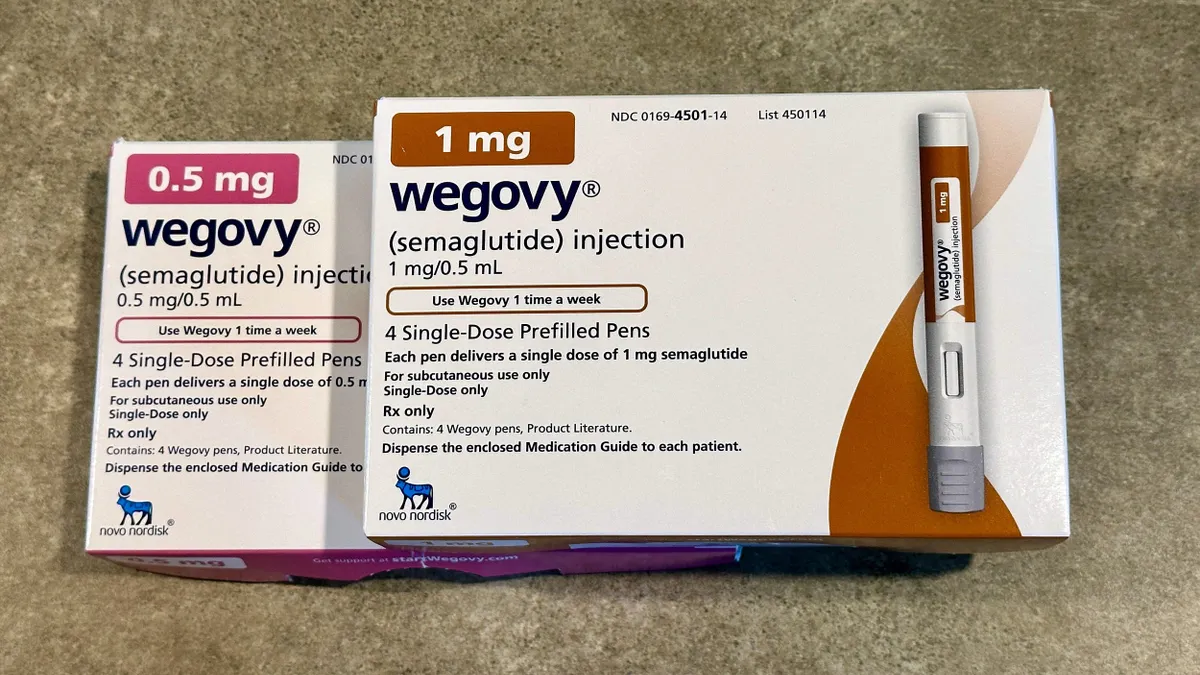
Lilly said it has now claimed 63% of the U.S. market and 58% of the overseas market for drugs modulating GLP-1 and other metabolic hormones called incretins. It will need to continue to add to its lead, as patents for Novo’s rival drugs Ozempic and Wegovy will begin to expire in 2031 and 2032.
But for now, the performance of Lilly’s dominant franchise “should quell investor concerns over GLP-1 growth” in the near term, Cantor Fitzgerald analyst Carter Gould wrote in a client note. — Jonathan Gardner
Novartis’ quick rebound
Novartis has spent much of the past two years trying to convince investors it has a solid plan for surviving one of the pharmaceutical industry’s steepest patent cliffs. But a couple major setbacks this past quarter sowed doubt about its prospects.
In a span of one week in September, the Swiss pharmaceutical firm delivered disappointing results from two trials that have been seen by investors and analysts as critical to its future. First, a cardiovascular disease medicine called pelacarsen — once viewed as a possible multibillion-dollar product — failed to protect heart health in a massive late-stage study. Then, del-desiran, a treatment it picked up in a $12 billion takeover of Avidity Biosciences, fell short in a Phase 3 study in a rare muscle disorder.
The two study failures caused shares to slide nearly 15%, erasing tens of billions of dollars in market value. And del-desiran’s stumble led Novartis to write off $1.9 billion of the Avidity deal, even though the company hasn’t yet given up on the drug. The charge was “primarily driven by the time line shifting out” and “the additional clinical work that needs to be completed,” CEO Vas Narasimhan told analysts this week.
Novartis won’t seek U.S. approval of pelacarsen, and isn’t yet sure whether it’ll advance another RNA-based drug similarly designed to lower levels of a protein particle called LP(a).
Yet despite those stumbles, the big drugmaker’s share price has largely rebounded and pushed higher following the latest earnings report. Third-quarter net sales hit $14.5 billion, just ahead of Wall Street estimates, thanks in large part to older drugs like Cosentyx, Entresto, Zolgensma and Ilaris. Novartis, in turn, slightly raised its 2026 outlook, something that analysts at Jefferies said “should be well received in the current market backdrop.”
Novartis’ breast cancer drug Kisqali and multiple sclerosis treatment Kesimpta also helped deliver a “solid” third quarter, RBC analyst Huynh wrote in a note to clients after the Tuesday earnings call. Overall, the company “delivered the clean quarter investors were looking for following a mixed quarter of pipeline readouts.”
A pill Novartis is developing for multiple sclerosis succeeded in a pair of Phase 3 trials and could, if approved, hit peak annual sales of $4 billion in that indication in the years to come, the company projected. And though sales of its prostate cancer drug Pluvicto slowed in the third quarter, they’re expected to ramp up next year, Novartis said.
“We do expect to get back to where we were, dynamic growth, in 2027,” Narasimhan said. — Gwendolyn Wu
GSK’s waiting game
GSK has made notable progress toward a plan to reinvent itself ahead of a sizable patent cliff. Multiple recent drug approvals, along with the steady progress of a growing oncology pipeline, have fortified its chances to rake in £40 billion in annual revenue by 2031.
In some respects, the numbers the British pharma reported on Wednesday suggested it has begun to see some returns on that strategy. Overall third-quarter sales rose by 5%, primarily driven by the performance of its specialty medicines, and were broadly in line with Wall Street’s expectations. GSK reaffirmed its full-year financial outlook, too.
Still, investors responded to the news by sending shares sliding by 5%. The headline numbers could be “masking underlying weakness,” wrote RBC Capital Markets analyst Trung Huynh. And GSK is also entering a period of “limited earnings momentum,” fewer readouts and questions surrounding its HIV business, added Jefferies analyst Michael Leuchten.
One lingering issue is an ongoing decline in vaccine sales, which missed analyst benchmarks in part due to the performance of the shingles shot Shingrix and the respiratory syncytial virus vaccine Arexvy. But some analysts also pointed to doubts about other pipeline products important to GSK’s future.
The long-acting asthma drug Exdensur, touted by GSK as a blockbuster-to-be, fell well short of expectations despite an increase in commercial coverage from 18% to 43%, Huynh wrote. The drug recorded £27 million in sales in the third quarter, and its launch will have to accelerate substantially to reach 2027’s consensus target of £373 million, he added.
That number didn’t alarm the company. On an earnings call, GSK’s President of Global Product Strategy, Nina Mojas, said there has already been a “significant increase” in new prescribers and that the summertime tends to be particularly slow in terms of patient visits. “We do expect to see a change in trend from now on,” she added.
Investors are also anxious about another pending readout. The company is testing a longer-acting version of its preventive HIV drug cabotegravir and has data in hand, but hasn’t yet shared it. An analysis is ongoing, and the company intends to bring the results to regulators by year’s end, said corporate development chief David Redfern.
“Obviously, we will update the market once that analysis is complete,” he added. — Delilah Alvarado