An experimental eczema drug from Pfizer met its primary goal in a mid-stage clinical trial, achieving stronger skin clearance in significantly more people at multiple doses compared to a placebo after 16 weeks.
According to detailed data from an ongoing Phase 2 trial shared at a European medical meeting Thursday, a substantially higher percentage of patients given Pfizer’s three-pronged antibody drug, tilrekimig, as opposed to a placebo experienced a 75% reduction in the scope and severity of their disease. The trial enrolled participants with moderate to severe atopic dermatitis, and the latest results build on data previously announced in March.
Analysts described the findings as “very strong” and indicative that Pfizer’s drug could compete with already approved therapies like Eli Lilly’s Ebglyss and Sanofi and Regeneron Pharmaceuticals’ market-leading Dupixent. In a statement Thursday, Pfizer said it has pushed tilrekimig into advanced testing for asthma, chronic obstructive pulmonary disease and atopic dermatitis — including a head-to-head trial against Dupixent.
“The compelling efficacy and tolerability demonstrated in this Phase 2 study validate this multi-pathway, trispecific approach and suggest that tilrekimig has the potential to raise the bar beyond current standard-of-care biologics,” Michael Vincent, chief inflammation and immunology officer at Pfizer, said in that statement.
Dupixent, a widely popular injection for autoimmune diseases, first entered the market for eczema in 2017. In the years since, it has been cleared for a range of inflammatory disorders and is a significant source of revenue for Sanofi and Regeneron, with net sales reaching almost $11 billion over the first six months of this year.
But the megablockbuster is facing looming competition as key patent protections are set to expire in 2031. Additionally, several biotechnology companies and large pharmaceutical firms, such as Johnson and Johnson, AstraZeneca and Lilly, are working to create the next generation of anti-inflammatories medicines.
Pfizer hopes to do the same. The pharma giant believes tilrekimig could become a new type of treatment that not only competes with, but surpasses the efficacy of drugs like Dupixent, while being a more convenient and potentially more durable option.
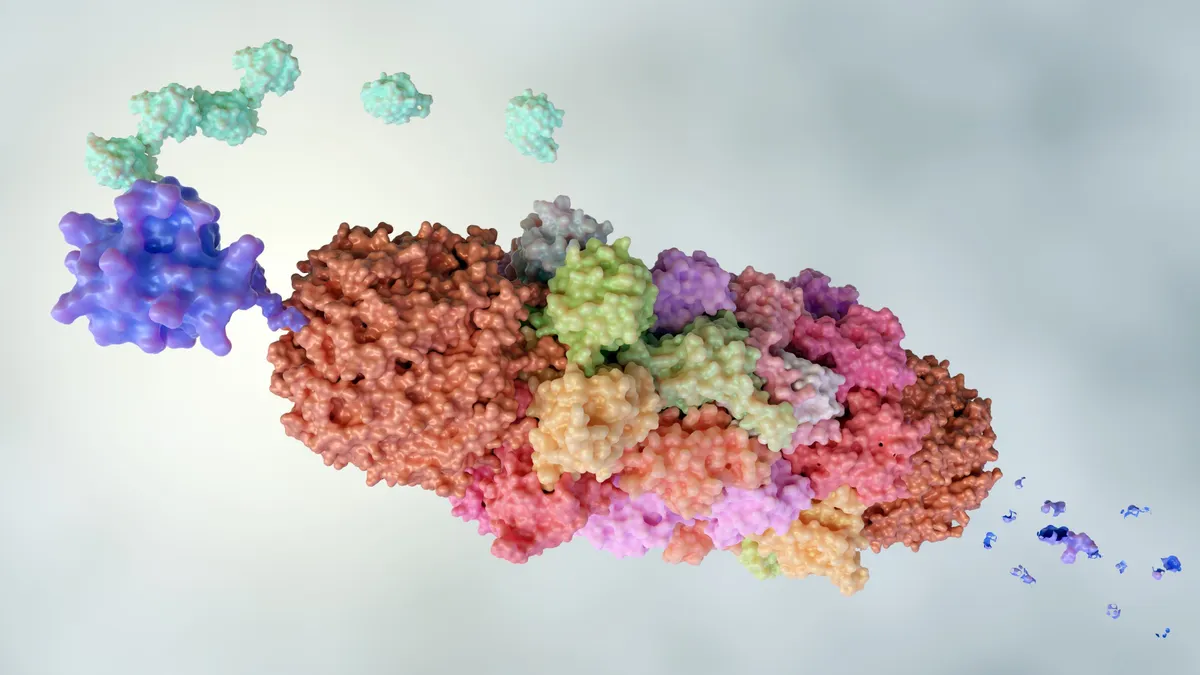
The drug is a “trispecific” antibody that inhibits three proteins — “IL-4,” “IL-13” and “TSLP,” or thymic stromal lymphopoietin — which are implicated in multiple immune diseases. By targeting the three proteins, Pfizer aims to provide broader coverage and deliver longer-lasting efficacy that can support a monthly dosing schedule.
The Phase 2 trial evaluated, across two stages, tilrekimig in people who had never taken a biologic medicine for their disease. In the first stage, about 63% of trial participants who got 450 mg of tilrekimig every two weeks achieved what’s known as “EASI-75” compared to 20% in the placebo group.
In the second stage, 48%, 61% and 57% of trial participants on 50 mg, 200 mg and 400 mg doses of the treatment every four weeks, respectively, achieved EASI-75 compared to 9% in the control arm. In a note to clients Thursday, RBC analyst Trung Huynh called the numbers “impressive” and competitive with rates seen with Dupixent and Ebglyss.
A key secondary endpoint focused on whether a patient’s skin is clear or almost clear, and showed that, in Stage 1 of the trial, 30% of participants on that 450 mg dosing schedule achieved this mark versus almost 12% on placebo. In Stage 2, 26% to 27% of participants across the groups achieved it, whereas none of the placebo group did.
Pfizer said tilrekimig was well-tolerated with no dose-dependent safety signals.
Though the numbers are “compelling”, Huynh wrote that “the competitive landscape continues to strengthen and quickly evolve,” and, so far, Pfizer’s drug has shown “minimal differentiation” from Ebglyss and Abbvie’s antibody zumilokibart, which is in late-stage testing.
Additionally, Huynh argued that it’s uncertain what TSLP targeting adds to the treatment of atopic dermatitis, so full Phase 3 data — which are expected to come in 2028 — will be needed to truly assess tilrekimig’s commercial potential.