
For most of its history, drug discovery could move no faster than laboratory research. Today, scientific AI is changing which experiments get run. Models trained on protein structures, genomic sequences, omics data and experiment results are enabling drug developers to accurately predict how molecules will behave and, increasingly, design new ones.
Since AlphaFold demonstrated that protein structures can be predicted with near-experimental accuracy, generative protein design has matured rapidly. Many computationally designed proteins now perform as intended during their first or second round of lab testing, and an ever-growing portion of drug discovery is done on GPUs.
As a result, choosing a computing infrastructure has become one of the most critical strategic decisions a drug developer can make. Scientific AI workloads are resource-hungry by nature. Training, fine-tuning and running terabyte-sized models at scale demands extensive GPU capacity, high-speed networking, and coordinated storage and orchestration. Frontier models are updated so often that infrastructure that meets present-day needs will quickly become outdated.
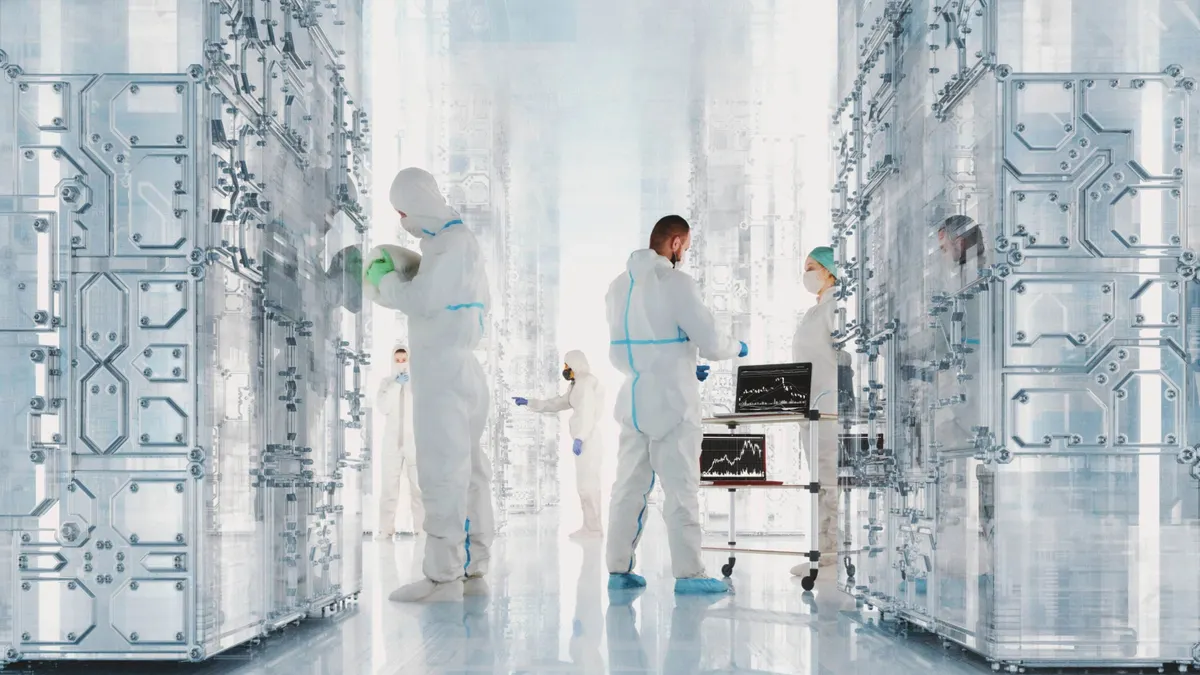
NVIDIA coined the term “AI Factory” to describe a specialized computing infrastructure purpose-built to satisfy these workloads’ requirements throughout the AI lifecycle, from data ingestion to model training, fine-tuning and high-volume inference.
Ilya Burkov, global head of scientific AI at Nebius, explains the concept: “Think of it like a manufacturing plant, but the product is scientific intelligence. The raw materials are the data that goes in, the production line is the compute, networking, storage, orchestration and models, and the finished goods are the predictions, insights and prioritized targets.”
A few of the world’s largest drug developers have built their own AI Factories. Eli Lilly’s LillyPod, which went live in February, runs on 1,016 NVIDIA Blackwell Ultra GPUs. Roche’s hybrid cloud AI Factory spans more than 3,500 GPUs across on-premises and cloud infrastructure.
But few biopharma and biotech companies can invest at that scale. AI cloud providers like Nebius make the same capabilities available to nearly any organization, without the upfront capital investment.
An AI factory turns scientific AI into a repeatable system
Most enterprises’ first experiences with AI involved implementing general-purpose tools like chatbots, coding assistants and productivity apps. Scientific AI’s needs are different. With protein structures, sequences and assay results as inputs and candidate molecules and binding-affinity scores as outputs, this type of AI requires large GPU clusters, high-speed networking and fast storage, all coordinated to run as if it were a single machine.
Most of today’s R&D teams are experimenting with AI by running one-off pilots, each with its own compute, data pipelines and vendors. An AI Factory replaces this patchwork of experiments with a repeatable system that multiple research teams can use to answer large numbers of scientific questions. Like a manufacturing plant, the AI Factory runs continuously and aims to improve performance with every cycle. Experimental results from each round go back into the models as training data, making each round of predictions better informed than the last.
Building your own AI factory takes more than GPUs
Building an AI Factory in-house requires sourcing power, GPUs and networking, as well as the entire software stack. Once data pipelines, orchestration and security controls are added in, an AI Factory’s costs total far more than compute alone. Keeping the factory running takes full-time performance engineers, and without regular hardware investments, it’ll never run anything newer than the GPUs it launched with.
Physical facility size limits what the builders of their own AI Factories can achieve, too. “A major challenge with an in-house buildout is that the space constrains the volume of insights you can create,” Burkov says. “It’s just like a traditional factory. Imagine you’re manufacturing car tires. You can only produce as many tires as the assembly line allows for.”
Scalable, on-demand access to an end-to-end AI platform
For many life sciences companies, the best solution is to access AI Factory capabilities without building one themselves. By choosing to run their workloads on a specialized AI cloud that was purpose-built for healthcare and the life sciences, drug developers can process vast amounts of research, diagnostic or bioinformatic data quickly and efficiently on scalable high-performance computing infrastructure.
In this model, the cloud provider manages the GPUs, networking and orchestration tools like Kubernetes and Slurm. Leveraging a cloud-native platform reduces the drug developer’s need for physical infrastructure while delivering ongoing access to state-of-the-art GPUs. For instance, teams could start on NVIDIA H100s, upgrade to B300s and continue moving to the latest silicon without needing to rebuild. Leading cloud providers offer extensive integrations, including with NVIDIA’s AI frameworks and models, bioinformatics pipelines and agentic search engines.
“If you build your AI Factory on the Nebius cloud, we provide the physical plant and the production line,” says Burkov. “All you need to bring is your data. You gain access to ready-to-use models that can be deployed with just one click, as well as open-source models that are available on a per-token basis, so there’s no need to rent entire GPUs.”
Among the biggest benefits of partnering with a specialized scientific AI cloud provider is access to facilities and expertise that few drug developers could assemble on their own. “We have dedicated teams in scientific AI, including solution architects and people with Ph.D.-level expertise in the life sciences,” Burkov adds.
“When you partner with us, you no longer have to think about infrastructure,” Burkov adds. “You can just concentrate on your workflow and the science behind it.”
Visit Nebius online to learn more about our life sciences and healthcare solutions.