Dive Brief:
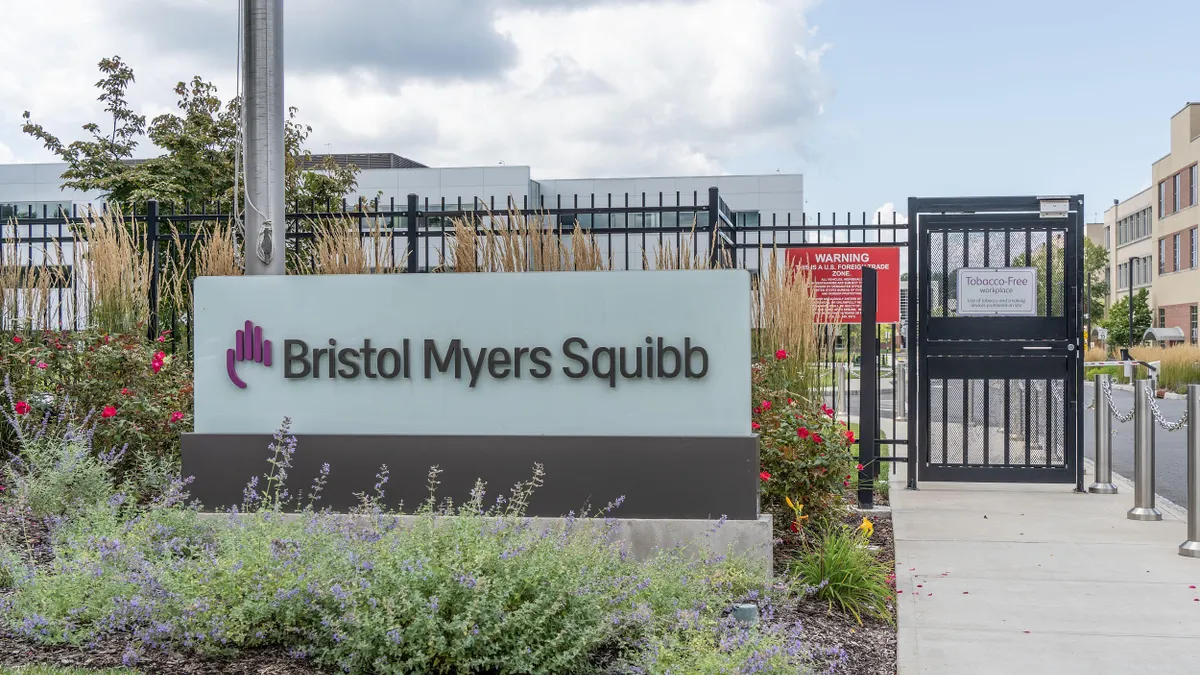
- Bristol Myers Squibb is combining its research and development departments, elevating Cristian Massacesi to the new job of head of R&D and saying goodbye to Chief Research Officer Robert Plenge, who came to the company with its $74 billion acquisition of Celgene.
- Massacesi, currently chief medical officer and head of development, will take on the new post as of Jan. 1, Bristol Myers said Thursday. Plenge will stay with the company through March 2027 to help with the transition.
- The “evolution” of the research and development organization will help speed decision making, improve portfolio management and “accelerate pipeline momentum,” Bristol Myers said. In the company’s statement, Plenge said he developed the new structure with Massacesi and is “confident it is the right path forward” for the company and patients.
Dive Insight:
Bristol Myers is reorganizing its research department as looming patent expirations threaten the sales of top medicines including the heart drug Eliquis, which brought in more than $14 billion last year.
To find products that can make up for lost sales, Bristol Myers is trying to make the most of drugs in development while looking outside for new prospects as well. There have been a few successes. In August, the company won approval for a multiple myeloma drug called Zenbexus. And another medicine for the condition, mezigdomide, delivered promising results in a study detailed in May.
But there have also been a few stumbles. A research failure set back a bid to widen the use of the heart drug Camzyos last year, and a trial of an experimental lung disease medicine disappointed investors in October. Meanwhile, a much-heralded schizophrenia medicine acquired in a $14 billion takeover of Karuna Therapeutics failed in a major study and has generated underwhelming sales so far.
In 2024, Bristol Myers said it would cut 6% of its workforce, consolidate facilities and trim its pipeline in a restructuring designed to strengthen its “long-term growth profile.” The company expanded the cost-cutting program the next year, saying it would slash another $2 billion by the end of 2027.
Since then, Bristol Myers has deepened its investment in artificial intelligence, betting on Anthropic’s Claude tool to tap all of its institutional knowledge. And it has an array of research readouts coming by the end of the first quarter of 2027. “We’ve made meaningful progress with our pipeline, and this evolution is about building on that momentum,” a company spokesperson said Thursday.
Plenge ran the inflammation and immunology business at Celgene before the 2019 acquisition. He then worked his way up in Bristol Myers, becoming head of research in July 2023.