This is the latest installment in a series where BioPharma Dive uses data visualization to recap what’s going on across the industry. Today, we’re looking at renewed interest in brain drugs and a muted investor response to the latest cell therapy research.
Despite its reputation as one of the most challenging and risky areas of drug research, neuroscience had, over the last several years, started to gain momentum among venture capitalists. Between 2023 and 2025, startups focused on the central nervous system took in $1.09 billion, $1.58 billion and $1.9 billion from 26 prolific venture firms, according to data compiled by BioPharma Dive.
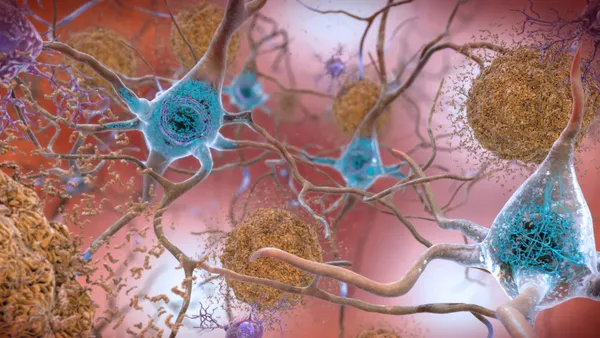
While the 2026 total hasn’t been as large, at $664 million by mid-November, a recent funding tear signals that brain drugs can still draw investors’ attention. Just this week, London-based Oyster Therapeutics said it had raised $60 million from a Series A round that was led by 4BIO Capital and saw participation from eight other parties, including pharmaceutical giant Eli Lilly. Oyster’s aim is to degrade a notorious protein with ties to Alzheimer’s disease.
Four other neuroscience biotechs — Setara Therapeutics, Delix Therapeutics, VectorY Therapeutics and Neurosterix — disclosed fundraising hauls since the end of October. Those rounds collectively brought in around $400 million.
A flurry of recent deals helped prop up what’s been a less active year for neuroscience VC
Elsewhere, public market investors had a mostly negative response to the latest data from some cell therapy developers who presented data this week at the American College of Rheumatology conference.
The annual meeting offered the latest look into how these cutting-edge therapies are faring against immune disorders like lupus and an uncommon condition known as systemic sclerosis. Philadelphia-based Cabaletta Bio, for instance, reported early, encouraging results from a trial testing its therapy “rese-cel” across three different diseases. The biotech’s share price has risen roughly 5% since the market’s close last week.
Conversely, shares of Nkarta, Allogene Therapeutics and Fate Therapeutics were all down more than 20% from Nov. 6 to Nov. 12. CRISPR Therapeutics also declined nearly 15%.
Investors largely balk at new research updates from cell therapy developers
Perhaps the best stock performance over the past few days was PepGen, whose experimental treatment for a muscle-wasting illness impressed Wall Street analysts.
According to PepGen, a mid-stage study of people with “myotonic dystrophy type 1” found the company’s drug helped repair, on average, 46.5% of the “splicing errors” that are a genetic hallmark of the disease. PepGen described the outcome as the “highest level of splicing correction ever” in a study testing multiple doses of a drug for this condition. And its stock subsequently surged north of 90%.
PepGen shares rocketed more than 90% earlier this week
Joseph Schwartz, an analyst at Leerink Partners, wrote in a note to clients that PepGen’s figure is higher than what researchers have seen with rival therapies from Novartis and Dyne Therapeutics. And while “cross-trial comparisons remain imperfect,” he added, “the magnitude and consistency” of the results “support clear best-in-class potential.”