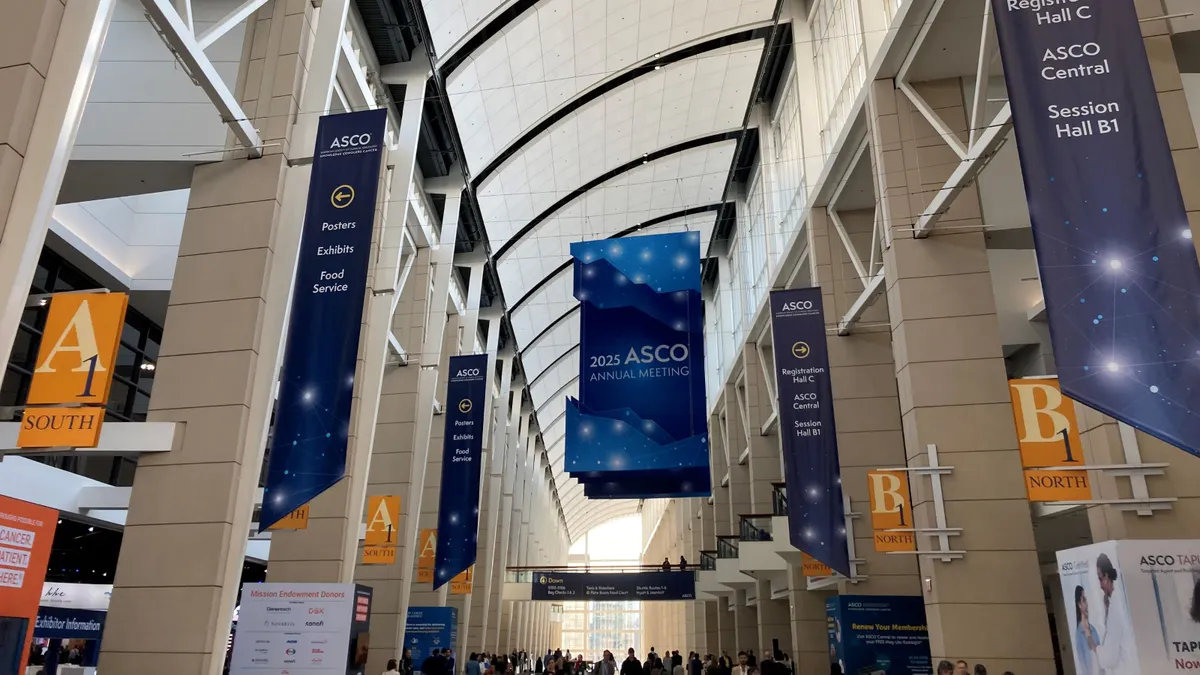
Today, we’re switching up our usual rundown of industry news to highlight some notable clinical trial updates ahead of next week’s annual meeting of the American Society of Clinical Oncology. On Thursday, conference organizers released abstracts, or snapshots, of most of the studies that’ll be presented at the gathering, which will be held in Chicago from May 29 to June 2.
The results unveiled Thursday don’t include so-called late-breaking abstracts, which usually spotlight particularly consequential study findings. Those data aren’t available until the day the relevant studies are presented. This year, that group includes highly anticipated readouts from studies of Revolution Medicines’ daraxonrasib in pancreatic cancer and Akeso and Summit Therapeutics’ cancer immunotherapy ivonescimab in lung tumors.
Abstract #8506
The upcoming ASCO meeting will include an important proof point for a drug Merck & Co. hopes to become a major part of its future.
Called sacituzumab tirumotecan, or sac-TMT, it’s an antibody-drug conjugate aimed at the “TROP2” protein expressed in many cancers. Merck licensed it through a broad alliance with Kelun Biotech. It has since advanced into a massive Phase 3 program, with 17 late-stage studies underway in a variety of tumors.
Last November, the two companies announced the ADC hit its goal in a Phase 3 trial in non-small cell lung cancer in China, but didn’t provide specific details. Those specifics have been eagerly anticipated by analysts and investors since then, as the magnitude of sac-TMT’s effects could hold implications not only for Merck, but multiple other cancer drug developers.
The abstracted study data unveiled Thursday from the “OptiTROP-Lung05” trial provided the first glimpse. When combined with Keytruda and administered to people with first-line non-small cell lung cancer, sac-TMT reduced the risk of disease progression by 65% compared to Keytruda alone. It also produced a response rate of just over 70%, versus 42% for Keytruda recipients, with study discontinuation rates either lower than or comparable to what was observed in the control arm.
The results were hailed by multiple analysts as “optically very impressive” and comparing “favorably” to existing treatment options. Leerink Partners analyst Daina Graybosch noted how they lower the risk involved in Merck’s global lung cancer trials for sac-TMT and support the drug’s positioning as a “bio-better chemo.” That strategy could put Merck on “equal footing” with emerging bispecific antibodies for lung tumors, Graybosch added.
Still, Stifel analyst Dara Azar cautioned that key differences in trial designs render comparisons to other bispecific drugs, like Akeso and Summit’s ivonescimab, tough to make. The findings present “no immediate threat to ivonescimab’s competitive positioning,” Azar wrote. — Delilah Alvarado
Abstracts #8513 and #8514
This year’s meeting will represent the latest proving ground for an emerging kind of cancer immunotherapy. China’s Akeso has a plenary spot, where it’ll unveil data showing how long one of these drugs, ivonescimab, extended the lives of study participants in a Phase 3 trial. But it won’t be alone, as multiple other companies advancing similar “PD-1/VEGF” inhibitors will spotlight their latest results too.
Wall Street investors and analysts are closely watching the results, as they’ll serve as early indicators of how those competitors stack up.
Two abstracts posted Thursday offered a glimpse of those findings. One involved “pumitamig,” a drug BioNTech and Bristol Myers Squibb are developing under a lucrative partnership. Another centers around SSGJ-707, which Pfizer licensed from China’s 3SBio last year.
Pumitamig’s results come from a portion of a global Phase 2 study evaluating two different doses of drug and chemotherapy in 44 patients with first-line non-small cell lung cancer. Study investigators reported a 70% response rate, with activity observed in patients with both non-squamous (74% response rate) and squamous (67%) disease. Adverse events judged as at least grade 3, or “severe,” were observed in 19 (44%) of patients and pumitamig was implicated in eight of those occurrences.
The results “validate” what’s been observed in China-based studies of other drugs in its class, but the study’s small size and lack of more meaningful reported outcomes on survival “limit the abstract’s utility,” wrote Leerink’s Graybosch.
Pfizer’s data, meanwhile, are from a study testing SSGJ-707 as a monotherapy in newly diagnosed non-small cell lung cancer patients. The new findings involve a key subgroup receiving the dose being used in pivotal testing.
According to the abstract, SSGJ-707 was associated with a roughly 68% response rate among the 34 patients who received that particular dose. Treatment among those study participants helped delay tumor progression by a median of about 12.4 months, and the median survival benefit hasn’t yet been reached. About 42% of SSGJ-707 recipients had grade 3-or-higher adverse events that were related to treatment, with the most common being pneumonia and high blood pressure.
Those findings are “in-line with the rest of the class,” and the efficacy results reported “should improve” with the chemotherapy combination regimen being tested in an ongoing, global Phase 3 study, wrote RBC Capital Markets’ Trung Huynh. — Ben Fidler
Abstract #7509
Eli Lilly has gained further assurance that the more than $3 billion it’s committed so far to buy Kelonia Therapeutics is money well spent. The lead asset from that deal is an “in vivo” CAR-T therapy for multiple myeloma. Called KLN-101, it is intended to be safer and more convenient than marketed “ex vivo” products that must be engineered from patients’ own cells in a cumbersome process.
The fresh ASCO data build on results from four patients that Kelonia presented at the American Society of Hematology meeting in December. The biotechnology company now has data from two different doses given to six trial enrollees, all of whom had relapsed after at least three lines of therapy. All six reached a response level called “minimal residual disease negative,” in which highly sensitive tests detect less than one cancer cell per million bone marrow cells.
MRD negative status is a sign that patients are at a low risk of relapse and have become increasingly important in the evaluation of myeloma drugs. The first treated study enrollee hit that mark within a month and has maintained the response through six months.
Four treatment recipients had an immune-related side effect called cytokine release syndrome that is common to CAR-T therapies, but they were rated as mild to moderate and successfully addressed with steroids and an immunosuppressive biologic. No patients so far have experienced another known cell therapy reaction that affects the nervous system.
In the abstract, investigators wrote that KLN-101’s safety profile could make it usable in an outpatient setting, unlike the inpatient care typically associated with ex vivo therapies. "The early data from this program continue to get better," wrote RBC's Huynh. — Jonathan Gardner
Abstract #9500
One of the more closely watched clinical trials in all of oncology research could read out sometime over the next 12 months, when Merck and Moderna are expected to reveal results from a Phase 3 trial evaluating a melanoma vaccine known as intismeran. Ahead of those findings, the partners posted updated findings from a mid-stage study analysts view as an important barometer for that trial.
In this mid-stage test, a combination of intismeran and Merck’s immunotherapy Keytruda is being tested against Keytruda alone in people with resectable melanoma. The experiment has already succeeded, but investigators have been tracking how long the apparent benefits on disease recurrence and survival have lasted. With five years of follow-up, investigators reported that the intismeran combination led to a 49% reduction in relapse risk and a 53% reduction in the risk of death. Some 92% of those receiving the vaccine were alive after five years as well.
Those findings are “important metrics for assessing the probability of success” in the late-stage study, “INTerpath-001,” testing a similar combination in adjuvant melanoma, wrote William Blair analyst Myles Minter.
Minter noted how the five-year results appeared “comparable” to what was observed after three years of follow up, which is indicative of a “sustained, consistent benefit.” Given the safety profile observed in testing so far, a five-year survival benefit of more than 90% wouldn’t even be necessary for “significant uptake,” Minter added. — Ben Fidler