Today, BioPharma Dive is switching up its usual rundown of industry news to highlight some notable clinical trial updates presented at the annual meeting of the American Diabetes Association. Over the weekend, several large pharmaceutical companies released new study data on prospects they hope will eventually become part of the next wave of weight loss medicines.
By and large, companies are hoping to break into a market currently dominated by Eli Lilly and Novo Nordisk. But Lilly and Novo are advancing their own new medicines, too, in a bid to stay ahead of the competition.
Below are three notable datasets and a look at how they’re being interpreted by investors and analysts.
Lilly’s reinforced ‘dominance’
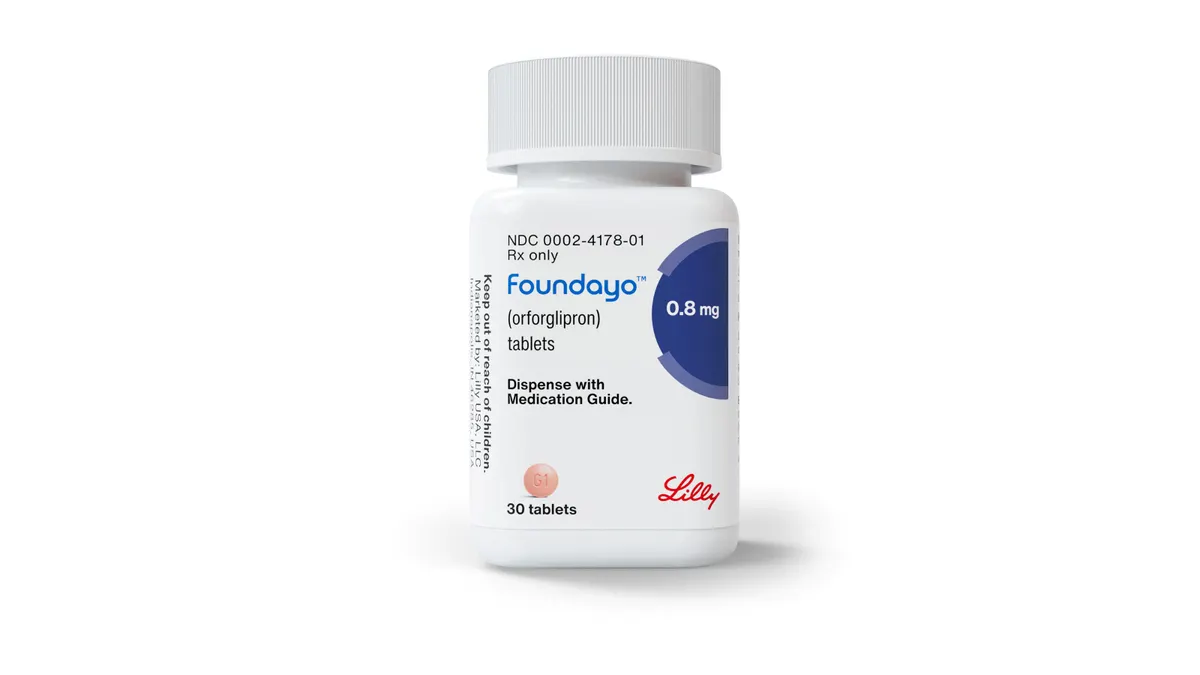
Lilly is already the market leader in obesity. Its top drug, sold as Zepbound for obesity and Mounjaro for diabetes, has become the world’s best-selling medicine. And a newly launched oral medication, Foundayo, is seen by analysts as a future blockbuster.
At ADA, a third medicine called retatrutide helped Lilly reinforce its “dominance,” wrote RBC Capital Markets’ Trung Huynh. Unlike existing therapies, retatrutide acts on three gut hormones instead of two or one. In clinical testing, that three-pronged approach is resulting in weight loss that surpasses other medicines. It’s giving Lilly’s franchise the kind of “durability and growth” that can extend to “2030 and beyond,” even in the face of growing pricing pressures and future generic competition, wrote UBS Securities’ Michael Yee.
In the “TRIUMPH-1” study in obesity, retatrutide recipients lost about 70 pounds, or 28% of their body weight, after 80 weeks. That total came in about 21 percentage points higher than what was seen with the placebo group and suggests retatrutide is ”effectively working as well as bariatric surgery, which is remarkable,” Yee wrote.
Still, there are at least some questions about what role retatrutide will play once it gets to a market that will already include multiple effective injectable and oral options. While retatrutide appears more potent than other drugs, higher doses also showed numerically greater rates of gastrointestinal adverse events than Zepbound, Yee wrote.
Given those characteristics, retatrutide use will likely “be limited to individuals at the higher end of the BMI spectrum, where the benefit/risk calculus is more favorable,” wrote William Blair’s Andy Hsieh. Zepbound will remain the “go-to medication” for the majority of people with obesity given its “balanced efficacy and tolerability profile,” he predicted.
Pfizer’s ‘foundational’ weight loss drug
Pfizer last year spent $10 billion to acquire Metsera and with it, a chance to break into the obesity drug market. The deal handed Pfizer a portfolio of next-generation weight loss medicines it views as important to future growth. Since then, analysts and investors have kept a close eye on its progress, starting with a shot that has the potential to be dosed less frequently than existing obesity treatments.
At ADA, Pfizer provided the latest update from three Phase 2b studies of that drug, now known as berobenatide, and laid out its path forward. In one study, a high weekly dose led to about 16% weight loss by 60 weeks. In another, maintenance doses ended up producing about 12% placebo-adjusted weight loss after 28 weeks. And a weekly dose evaluated in a test in patients with obesity and Type 2 diabetes yielded weight loss of around 10 percentage points better than a placebo, RBC’s Huynh wrote.
Those findings position berobenatide, for the moment, as “in line” with Lilly’s fast-selling Zepbound, according to Huynh. But the drug’s tolerability remains a concern. Hyunh noted how study discontinuation rates touched as high as 21% in a trial evaluating monthly doses. And though cross-trial comparisons come with caveats, nausea, vomiting and diarrhea were more frequent in Pfizer’s studies than what’s observed in testing of Zepbound, he wrote.
Pfizer sees berobenatide as a “foundational medicine” with potential as a monotherapy or part of combination regimens, wrote Leerink Partners’ David Risinger. The company has 10 planned or ongoing Phase 3 trials and could announce the first late-stage results in the second half of 2027. Initial late-stage data from a monthly regimen might follow in 2028.
“We need to see Phase 3 monthly efficacy and tolerability results in 2028 to understand its profile,” Risinger wrote.
Roche’s ‘me-too’ medicine
Like Pfizer, Roche has used dealmaking to buy its way into the obesity drug chase. Licensing agreements and acquisitions — most notably, a multibillion-dollar deal for the biotech Carmot Therapeutics — have yielded a group of prospects it believes to be competitive with existing therapies. Roche has claimed the three drugs it inherited from Carmot could be “best in class.” Analysts and investors haven’t been so sure, however.
Data presented at ADA are “unlikely to change” those views, wrote Jefferies’ Michael Leuchten. The highest dose of Roche’s lead program, a dual injectable therapy known as enicepatide or CT-388, led to placebo-adjusted weight loss of anywhere from 18% to 22.5% depending on the efficacy measure — numbers just above Zepbound’s pivotal results, Leuchten wrote. But its side effect profile appeared “modestly worse” than what’s available, leaving the Jefferies team wondering how Roche might position a treatment that’s “largely undifferentiated” and well behind multiple other options.
“These results do little to differentiate enicepatide from its peers and position it as a late-comer, me-too option if it ever reaches the market,” RBC’s Huynh wrote.